
Conclusion
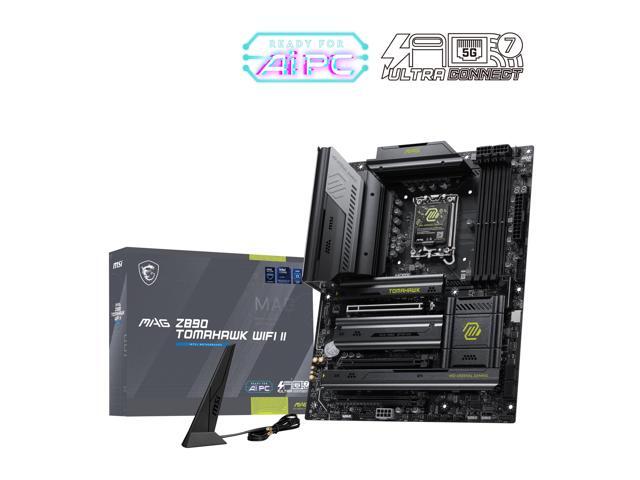
In our review, we examined the MSI MAG Z890 TOMAHAWK WiFi II motherboard. This board is a “refreshed” version of the MAG Z890 TOMAHAWK WiFi, which we reviewed in December of 2024. In keeping with the MAG TOMAHAWK branding, this is a full-sized ATX board which supports the latest socket 1851 Core Ultra CPUs from Intel, DDR5 memory, including full support for CU-DIMMs and Gen5 NVME and PCIe. We found design and performance to be directly on par with two other recently reviewed Z890 chipset motherboards.
Installation and Use
We had no issues with installing components on this motherboard, nor did the first boot show any problems. There is ample space around the CPU. RAM slots have a single clasp on the far end due to the placement of the CPU power sockets on the right top. Memory should not interfere with heatsink placements. M.2 installation is tool-less except for the middle slot#2 heatsink, which needs a screwdriver. The second M.2 may not be usable if the native heatsink is too tall, as it sits directly under the primary GPU placement. This is not an uncommon finding. The primary PCIe is reinforced and uses the EZ-PCIe Release. Overall, the board design presents no issues and is unchanged from the OG.
First boot, BIOS navigation, and Windows 11 installation were without a single hitch. The BIOS is very similar, if not identical, to the other MSI motherboards we have reviewed in the recent past. We had no issues updating the BIOS to the most recent release using the “M-Flash” software. The Click X BIOS is very responsive and well-organised. All benchmarks ran without error. VRM temperatures were very unremarkable on this board during prolonged Cinebench R23. There were no thermal issues.
Final Points
As we do in every review, data and specifications regarding the motherboard are researched. In the case of a “refresh” or update or Roman Numeral release, we search for a comparison between boards to see what was added or improved. With the MSI MAG Z890 TOMAHAWK WiFi II, we looked and looked, and only the obvious showed through. There is one less USB4-C (aka Thunderbolt) port on this board compared to the OG released in late 2024. Less obvious is the fact that the WiFi module on the Z890 TOMAHAWK WiFi II has been downgraded from an Intel Killer to a MediaTek. While it still supports WIFI 7, it has been downgraded, dropping from 320MHz to 160MHz. That’s it. That’s all. Otherwise, the OG and the “refresh” motherboard versions are the same; in fact, the refresh is a bit of a downgrade in features specifically.
Now, this is a fine, well-built board, and it has all that you would expect from the MAG TOMAHAWK line. It performs well, and it was flawless throughout testing. We suppose this board was released as it is to keep costs reasonable, since that is what the MAG line of motherboards is about, anyway. If you go to the MSI storefront page, the OG has dropped in price from $259 to $229, and the MAG Z890 TOMAHAWK WiFi II is now $199, 30 bucks less than on release. (and as a matter of fact, a full $30 less than the OG). It’s up to the buyer to decide if two USB-4 and faster WiFi is 30 dollars better than one USB-4 and slower WiFi. Nonetheless, this MAG Z890 TOMAHAWK WiFi II performed well and was exactly as we have come to expect.



Discussion (1 reply)
Join Discussion →So less connectivity.. good for.a new build but as a consumer i could see buying this expecting the same or better as the previous Gen and being pissed.to discover its not. Then again I dont have antlything that uses my Gen 4 usb ports on my motnerboard so...