
System Benchmarks
First, we will start with some system and rendering benchmarks: 3DMark, Cinebench 2026, and Geekbench 7. This will give us an idea of how the CPUs compare outside of gaming.
3DMark
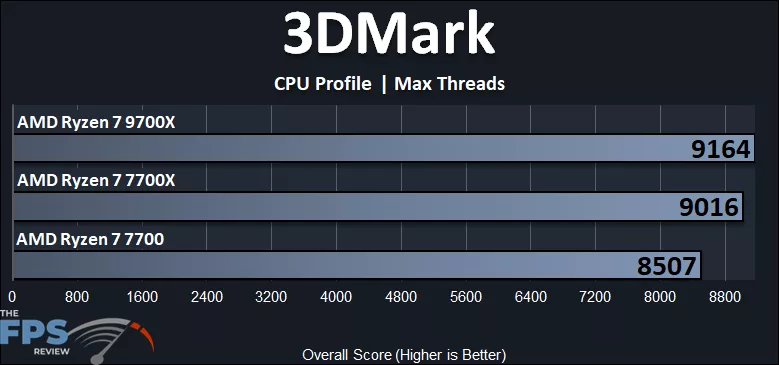
Starting with our synthetic benchmarks, we are looking at 3DMark’s CPU Profile test, this one is Max Threads and tests the CPUs in an all-core load. Right off the bat, in this test, the Ryzen 7 9700X is only 2% faster than the AMD Ryzen 7 7700X it supersedes. Not a good start for a performance uplift over the previous generation, when all the cores are being loaded. However, the clock speed difference compared to the Ryzen 7 7700 does allow an 8% performance advantage. This is interesting because both CPUs are 65W TDP CPUs, and the 9700X is 8% faster at the same power, so that’s positive at least. The Ryzen 7 7700X is 6% faster than the Ryzen 7 7700, but uses a lot more power to get there.
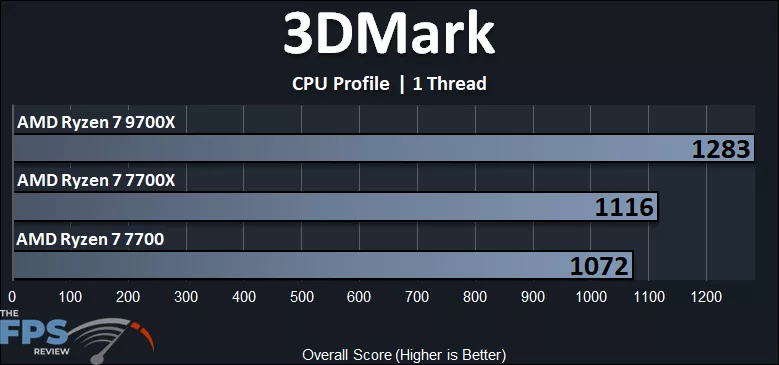
The scene completely changes, however, when looking at 1-Thread or Single-Core performance. The AMD Ryzen 7 9700X is 15% faster than the Ryzen 7 7700X, at a LOT less power! That’s pretty significant, and this is the kind of performance jump we would want gen-to-gen; at least we’re seeing it in the single-thread workload. Compared to the Ryzen 7 7700, the Ryzen 7 9700X is 20% faster than that CPU at the same power! The Ryzen 7 7700X is 4% faster than the Ryzen 7 7700, but uses more power.
Cinebench 2026
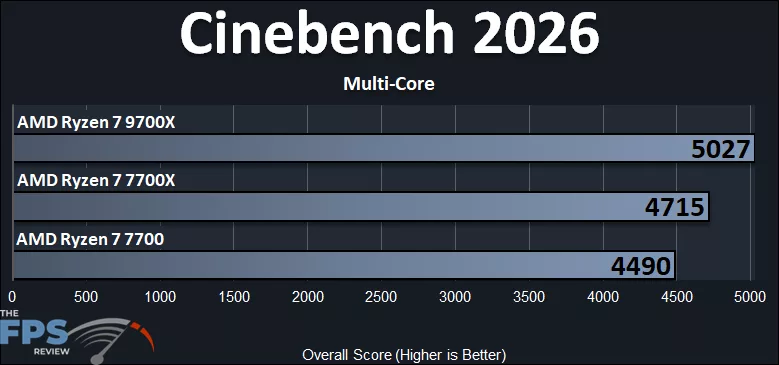
In Cinebench 2026, which stresses all cores, the Ryzen 7 9700X is 7% faster than the Ryzen 7 7700X. It’s not as much as we’d like to see, but it is at least something noticeable in Cinebench 2026 rendering. The Ryzen 7 9700X is 12% faster than the Ryzen 7 7700 at the same TDP. The Ryzen 7 7700X is 5% faster than the Ryzen 7 7700.
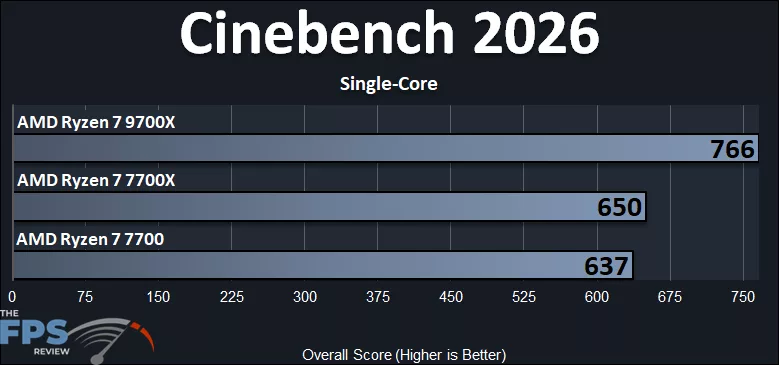
Single-core performance uplift is where the Ryzen 7 9700X seems to shine. In Cinebench 2026, the Ryzen 7 9700X is 18% faster than the Ryzen 7 7700X in the Single-Core workload. This is very significant. The Ryzen 7 9700X is 20% faster than the Ryzen 7 7700. The Ryzen 7 7700X is only 2% faster than the Ryzen 7 7700.
Geekbench 7
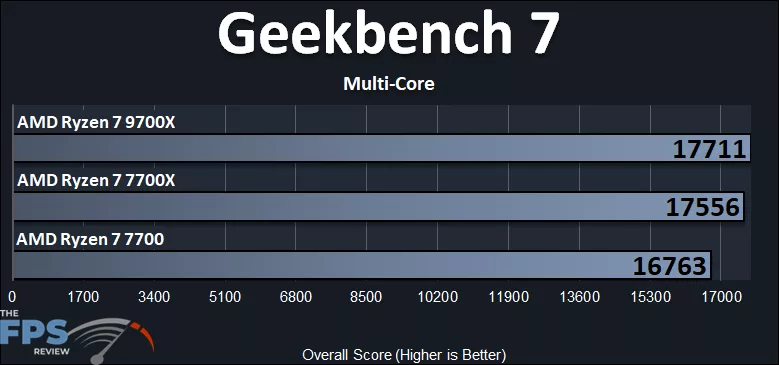
In Geekbench 7, the overall testing replicates what we saw in 3DMark. The Ryzen 7 9700X is only 1% faster than the Ryzen 7 7700X in an all-core workload. Compared to the Ryzen 7 7700, the Ryzen 7 9700X is only 6% faster. The Ryzen 7 7700X is 5% faster than the Ryzen 7 7700.
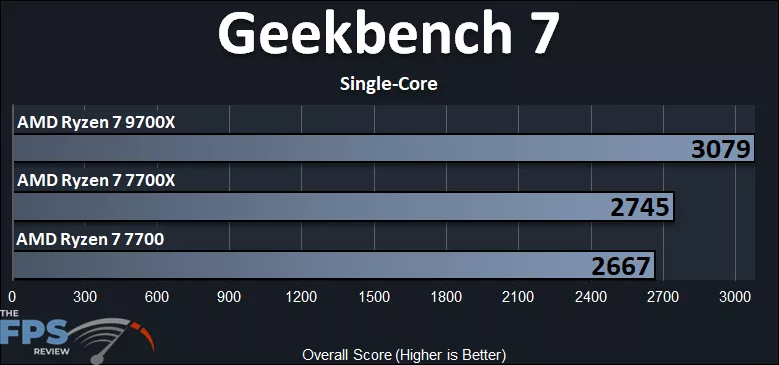
Once again, it is the Single-Core testing that shows the Ryzen 7 9700X in the best light. The Ryzen 7 9700X is 12% faster than the Ryzen 7 7700X and 15% faster than the Ryzen 7 7700. The Ryzen 7 7700X is 3% faster than the Ryzen 7 7700.
Discussion (6 replies)
Join Discussion →I hate to say it, but honestly, I think the question is
"Are socketed CPUs still a thing"
I hate to be Debbie Downer, but I really am just not very optimistic about this hobby moving forward.
Feels kinda like HAM radio or 35mm photography - it may never die out entirely, but the spark seems to be gone.
Seems just as soon as we clear one catastrophe - something else pops up and says "Hold My Beer". I mean, I sure didn't have AI Apocalypse on my Bingo card, after surviving floods, famine, plague, power outages, two cryto mining booms, overstocks, near bankruptcies, and whatever else has happened in the last decade and a half or so.
Honestly that is a very fair question. Are CPU's the last bastion of DIY. Are we going to have SOC's only going forward. I think chances of that are greater than any of us really want.
It's kind of a weird situation right now, for sure. CPUs are the more interesting thing. With Nova Lake and Zen 6 coming up, that will get the most attention right now for DIY builders.
I think a big answer to this will be what the foundries do with the demand that is being 'dammed' up due to lack of supply.
Definitely represents a solid market segment for whoever manages to address it.
Intel has had the ability to address this market for decades. I look forward to their first attempt...
I hope this is the case, but I'm afraid younger generations have just went "meh, i got a phone" and call it good.
AI and other datacenter demand is going to hit a wall at some point; no one wants to say it out loud and spook investors, but it can't keep going forever, and these fabs are going to have to find new customers when it does.
I imagine in three to five years a new generation will be learning all about PC gaming for their first time...