
Introduction
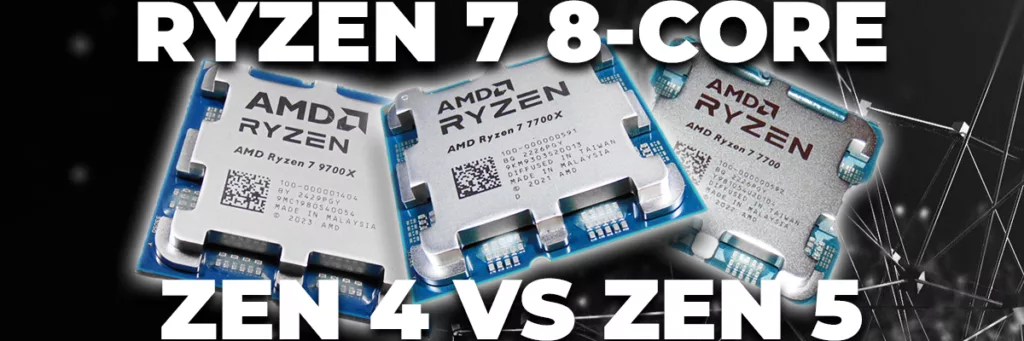
Is “Zen 5%” still a thing in 2026? We are going to run through all Zen 4 and Zen 5 AM5 8-Core NON-X3D CPUs to find out, with all fresh new data tested as of September 2026. Our goal is to see how the standard 8-Core CPUs from Zen 4 and Zen 5 compare in games primarily, but we’ll throw in a few synthetic benchmarks as well. We’ll have average FPS and 1% Lows tested and compared in 12 games on a GeForce RTX 5090 at 1080p. This will include the AMD Ryzen 7 7700, AMD Ryzen 7 7700X, and AMD Ryzen 7 9700X AM5 CPUs going head-to-head in this comparison review.
Ryzen 7000 & 9000 History
The AMD Ryzen 7000 series desktop processors, based on the AMD Zen 4 architecture, introduced the AMD AM5 platform in September of 2022. This was a huge launch, as it not only introduced a whole new series of CPUs but also a brand new CPU architecture (Zen 4), a completely new CPU socket platform, and a chipset with the introduction of DDR5 memory as well. It was a big step up from the AM4 platform and Zen 3 CPUs. The AMD Ryzen 7 7700X was AMD’s flagship 8-core CPU at the time, and it was also launched in September of 2022 at an MSRP of $399. The cut-down Ryzen 7 7700 8-core CPU followed, with a launch in January 2023 at an MSRP of $329.
The next generation to follow was the AMD Ryzen 9000 series of desktop processors, based on the AMD Zen 5 architecture, also based on the AM5 platform these CPUs launched in August of 2024. This was a smaller launch, as the primary difference was just an upgrade in architecture from Zen 4 to Zen 5. The CPUs would already take advantage of the previously released AM5 DDR5 platform and newer chipsets offering better connectivity support. The AMD Ryzen 7 9700X was AMD’s flagship 8-core CPU of this generation, and it was also launched in August of 2024 at an MSRP of $359.
The Zen 5 Rocky Start
The Zen 5 architecture got off to a rocky start, offering little advantage in real-world performance over the previous generation. It varied, with some applications and workloads showing better performance results, and others, such as games, showing very little in the way of real-world performance upgrades. It was small, to the extent that Zen 5 quickly garnered the meme: “Zen 5%“, because this was about the average gaming percentage uplift one could expect with the new CPU architecture. In our own review of the AMD Ryzen 7 9700X at launch, we also experienced very low percentage differences over the previous generation. Our general recommendation in that review was that the Ryzen 7 9700X was not worth the upgrade at the time.
Then, shortly after release, AMD made some announcements regarding improving Zen 5 performance in some key ways. One of those ways was to raise TDP for two of its CPUs; another was reduced core-to-core latency for the dual-chiplet CPUs, and another was Windows Updates that would bring performance. AMD would also release new BIOS versions that would improve performance over time. We even gave our own analysis of some of these updates in this YouTube video on the subject.
Indeed, many updates did come out over the past couple of years, both in terms of new BIOS versions, new Windows updates, and AMD Chipset driver updates, as well as better performance profiles. Since the launch of 2024, Zen 5 performance has changed. The question, though, is by how much? Consider that ALL of these updates can also affect, or ‘bring up,’ Zen 4 performance as well. So we thought it is time to completely re-test Zen 4 and Zen 5 on the same platform, same current BIOS version, same current Windows Update version, same current Chipset driver version, and the latest games to see how they stack up now in 2026, two years after the fact.
Ryzen 7000 & 9000 Specs
| Ryzen 7 9700X | Ryzen 7 7700X | Ryzen 7 7700 | |
|---|---|---|---|
| Architecture | Zen 5 | Zen 4 | Zen 4 |
| Cores/Threads | 8/16 | 8/16 | 8/16 |
| L3 Cache | 32MB | 32MB | 32MB |
| Total Cache | 40MB | 40MB | 40MB |
| Base Clock | 3.8GHz | 4.5GHz | 3.8GHz |
| Turbo Clock | 5.5GHz | 5.4GHz | 5.3GHz |
| TDP | 65W | 105W | 65W |
| MSRP | $359 | $399 | $329 |
All three CPUs are 8-core/16-thread CPUs, with the same amount of L3 and total Cache. They vary in architecture, clock speed, and TDP. Though the AMD Ryzen 7 9700X runs at the highest Turbo Clock of 5.5GHz, its TDP is actually lower than that of the Ryzen 7 7700X it supersedes, at 65W compared to 105W. Also, the Base Clock is much higher on the Ryzen 7 7700X at 4.5GHz, compared to 3.8GHz on the Ryzen 7 9700X. The Ryzen 7 7700 is a clock reduced Ryzen 7 7700X, with a lower Base Clock, and the Turbo Clock at 5.3GHz, also a lower 65W TDP. The Ryzen 7 9700X’s MSRP was reduced, however, compared to the Ryzen 7 7700X by $40 at launch. All three CPUs run with DDR5 memory, of course, and DDR5 6000MT/s is the sweet spot for all three CPUs.
Discussion
Join Discussion →No replies yet. Be the first to reply on the forum.