
Synthetic System Benchmarks
We are going to start with synthetic system application benchmarks on this page. Gaming performance will be shown later on. Note that the graphs are arranged from fastest to slowest and contain all the CPUs on each graph for a large comparison. The Ryzen 9 7900X is highlighted in orange.
PCMark 10
Standard PCMark Benchmark

In PCMark 10’s full system benchmark the AMD Ryzen 9 7950X is 14% faster than the previous generation Ryzen 9 5950X it is replacing, that is the difference in performance you are looking at from the older CPU in this benchmark. Compared to the Ryzen 9 7900X the Ryzen 9 7950X is 0.5% faster than the Ryzen 9 7900X if you want to know what the difference between the two is in this benchmark. Compared to the Intel Core i9-13900K the Ryzen 9 7950X is only 2% slower in this system benchmark.
PCMark Application Benchmark
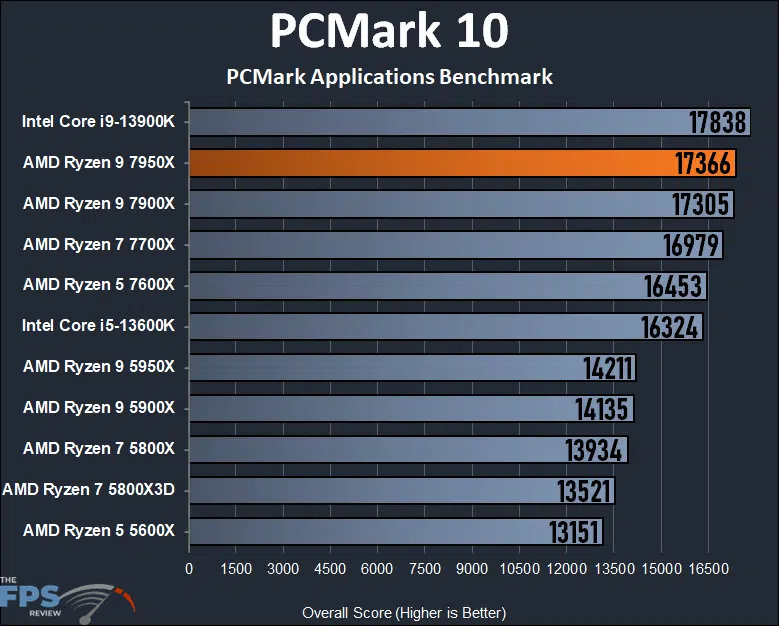
In this graph, we are looking at PCMark 10’s Applications Benchmark. This test is very specific, it tests the performance of Microsoft Office, using Excel, Word, PowerPoint, and even Edge. We are using Microsoft Office 2021 for these tests. Compared to the older Ryzen 9 5950X the new Ryzen 9 7950X brings a larger 22% performance upgrade in Microsoft Office performance, which is pretty substantial for office work. Compared to the Ryzen 9 7900X the Ryzen 9 7950X is 0.3% faster, so basically, the added cores do not improve performance for MS Office. The Ryzen 9 7950X is 3% slower than the Intel Core i9-13900K.
Geekbench 5
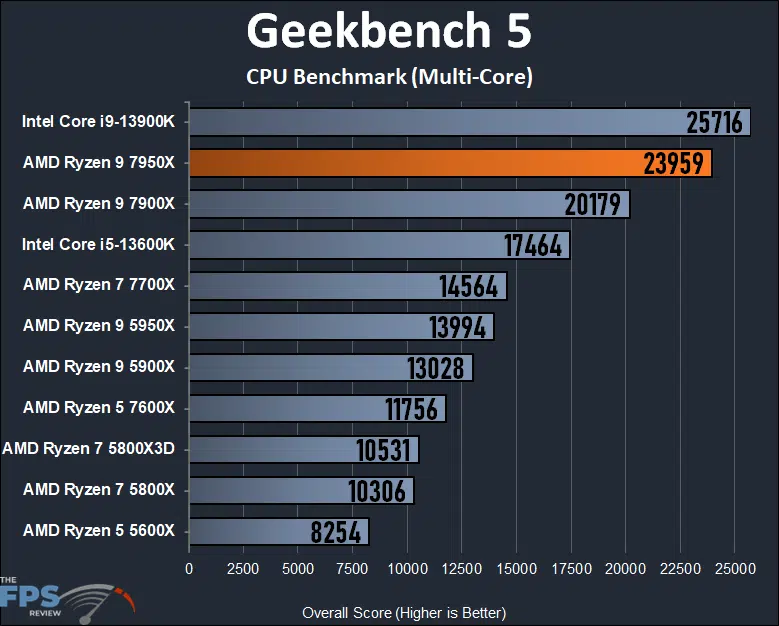
In Geekbench 5 Multi-Core performance the new Ryzen 9 7950X is a very fast 71% faster than the previous generation Ryzen 9 5950X, despite both CPUs having the same core/thread count. This shows a tremendous upgrade in multi-core performance from the previous generation. Compared to the Ryzen 9 7900X the Ryzen 9 7950X is 19% faster with the additional core/thread difference it has over the 7900X. Compared to the Intel Core i9-13900K the Ryzen 9 7950X is 7% slower in this benchmark.
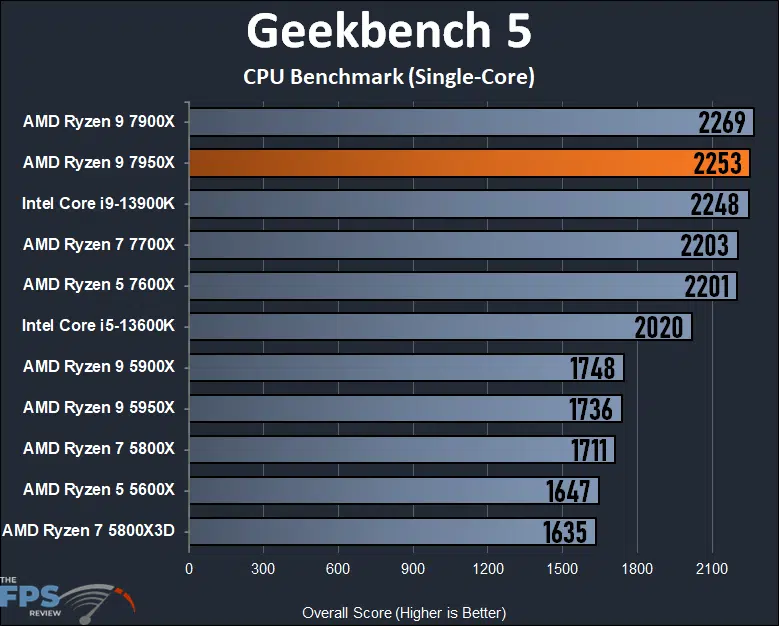
In Geekbench 5’s Single-Core testing the new AMD Ryzen 9 7950X is 30% faster than the previous generation Ryzen 9 5950X, which is a very nice IPC and performance uplift for single-core performance. Compared to the Ryzen 9 7900X the Ryzen 9 7950X is 0.7% slower, which is very close and within the error of margin. Compared to the Intel Core i9-13900K the Ryzen 9 7950X is 0.2% faster.
Discussion (4 replies)
Join Discussion →I love the graph at the bottom that shows how you came up with the review score - awesome review.
Thanks, @Brent_Justice for the great review! I'm keeping a keen eye on all these new processors as I gather knowledge for my next build. I can't wait to see what the 3D Cache 7000 series does.
Nice review... yea I'm definitely skipping this generation of CPU's my 5900x is plenty fast for what I do at 1440p.
Great review! Now how do I cool the stupid thing? And is my "old" 800w power supply going to keep up?
Microcenter has the 7950x + 32gb ddr5 6000 gskill ram for $567, and the 7900x same ram bundle at $469. Looking at those gaming charts, 4k is totally GPU bound, but 1440p seems to be the sweet spot. I think I would swing for the 7900x personally.
I also play (more than I should) a fair amount of Civ 5 + Vox populi.... it is my understanding it is a mostly single threaded game. I have cranked my 5700x to the max while playing, trying to cut down on the time between turns when AI is working.... doesn't seem to make much difference. I see one or 2 cores pegged out and the rest do nothing. So I'm not even sure the $567 upgrade (and $250+ for a new mobo) would make a difference. I generally prefer AMD to Intel these days, but it seems like Intel does better on the single threaded stuff?