
Power, Temp, and GPU Clock
To test the power and temperature we perform a manual run-through in Cyberpunk 2077 at “Ultra” settings for real-world in-game data. We use GPU-Z sensor data to record the results. We report on the GPU-Z sensor data for “Board Power” and “GPU Chip Power” when available for our Wattage data. For temperature data, we report the GPU (Edge Temp of the GPU or Package Temp) as well as Hot Spot (Junction Temperature) when available for our temperature data.
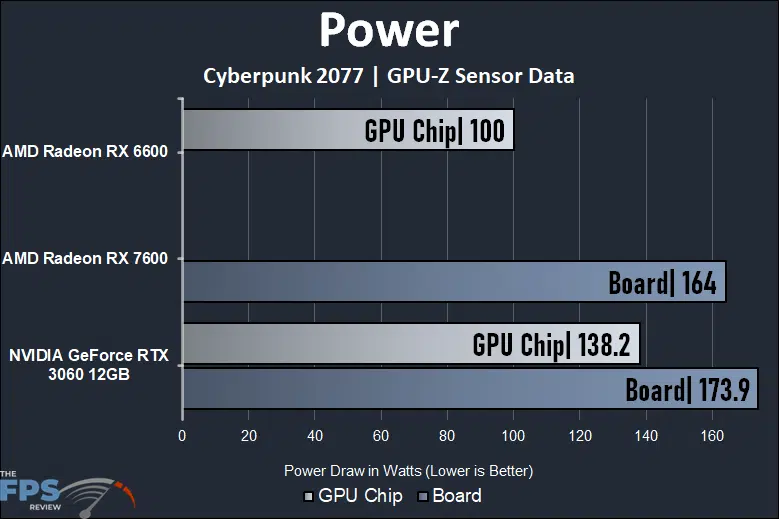
The Total Board Power (TBP) of the AMD Radeon RX 7600 is 165W. In our testing, playing Cyberpunk 2077, we tested 164W Board Power using GPU-Z. GPU-Z does not currently show GPU Chip power on the Radeon RX 7600, and it also does not show Board Power on the Radeon RX 6600, so we cannot compare them exactly. However, it does seem like the Radeon RX 7600 will use more power than the Radeon RX 6600 which has a TDP of 132W.
Compared to the GeForce RTX 3060 12GB video card we are using, which is an EVGA GeForce RTX 3060 XC BLACK GAMING, it reached a Board Power in GPU-Z of 173.9W. Therefore, the new Radeon RX 7600 actually uses less power than the GeForce RTX 3060 12GB by about 6% board power. We also know that it performs much faster than the RTX 3060 12GB, therefore it is efficient compared to the RTX 3060 12GB.
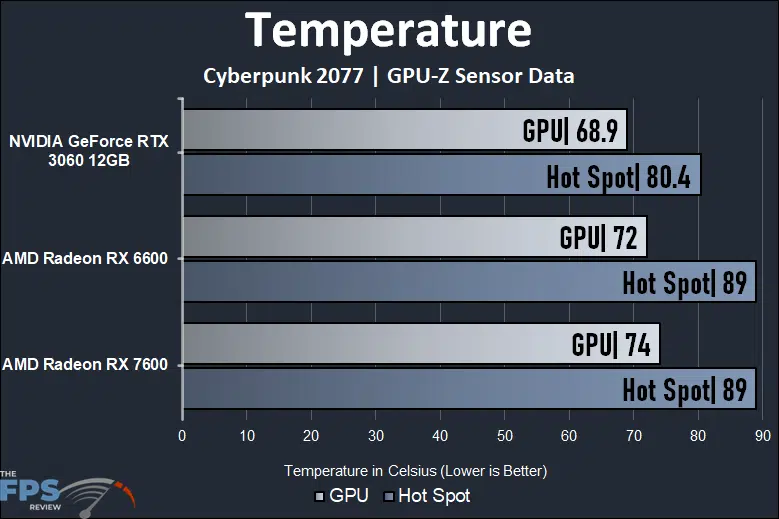
Though the Radeon RX 7600 uses less power than our EVGA GeForce RTX 3060 XC BLACK GAMING video card, its temperatures actually run hotter. The Radeon RX 7600 had a maximum GPU temp of 74c and a hot spot of 89c. These temperatures are very close to our custom SAPPHIRE PULSE Radeon RX 6600 GAMING video card. This all comes down to the cooler used, the other two video cards were custom AIB builds with custom coolers. The Radeon RX 7600 cooling will depend on the AIB card you buy, and this particular one is the Made by AMD model. It appears that its cooling may not be as robust as a custom cooler, but we will have to test more cards to compare it with. The end result is that the fan speed did not seem loud to us.
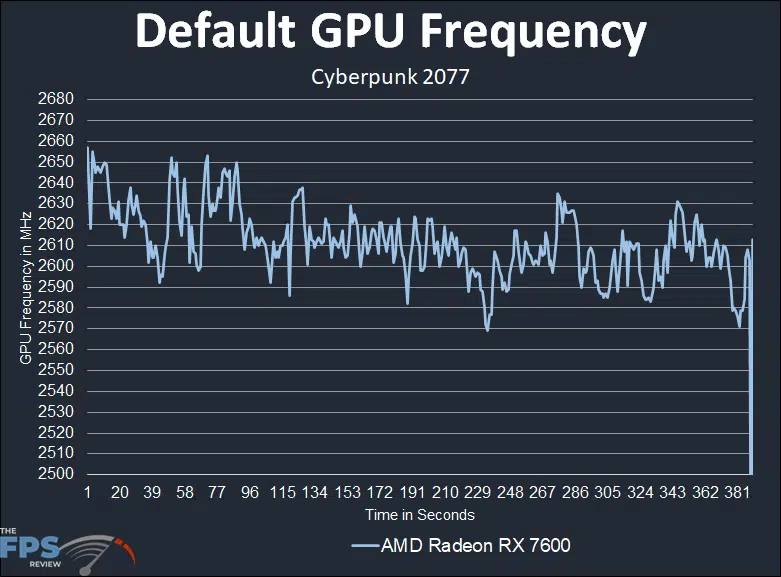
The AMD Radeon RX 7600 has a Game Clock of 2250MHz and a Boost Clock of up to 2625MHz. In our graph above we are playing a real game, Cyberpunk 2077, while playing we can see that the frequencies start high, and do decline slightly over time. We also see very dynamic clock speeds, that fluctuate from 2570MHz up to 2650MHz. The clock speed seems to remain mostly below the Boost Clock of 2625MHz. Taking the average of the clock speed, the end result is an average clock speed of 2611MHz. Better cooling may help stabilize and keep the frequencies higher, so we look forward to custom AIB card designs.
Discussion (12 replies)
Join Discussion →Performance is a bit disappointing.
I would have liked something between a 6700xt & 6750xt level.
As the 700watt 7990xtx showed, RDNA 3 can scale in frequencies given the power.
So maybe a 16gb 7600xt that matches 6750xt for $350 is possible !?
Or a 16gb 7600xt that matches 6700xt for $330 !!??
Lovely review... just making a couple notes.
1. Your math is off with this statement: "Compared to FSR performance on the previous generation RX 6600 the new RX 7700 with FSR is 20% faster." Some quick armchair excel work shows that with FSR compared to the 6600 with FSR the 7600 is actually 23.8 or roughly 24% faster. If you want me to explain my math I'd be glad to! :) Now 20% would be correct to say the 6600 with FSR is 20% slower than the 7600 with FSR. :) I know it's nitpicky... but I'm professionally nitpicky.
I'm not going to armchair math the rest of the statements... Just this one lol.
Interesting review if I were a new gamer on a budget and wanted 1080 gaming I would have no issues using this card.
If you can move the budget up by $50, then you get the 12gb 6750xt
https://www.newegg.com/msi-rx-6750-xt-mech-2x-12g-oc/p/N82E16814137735?Item=N82E16814137735
AMD fine wine effect will see ftbe 7600 exceed the 6750.
I double checked the math, FSR to FSR the math seems correct. 104-87/87*100 gives 19.5% performance advantage. Double Checking here: https://www.calculator.net/percent-calculator.html?c3par1=87&c3par2=104&ctype=3&x=43&y=15#pctdifference 104 is a 19.5% increase of 87.
NOTE: I have added a section under the Test Setup Page that clarifies a driver issue that could be skewing results between some reviewers and testing. I just wanted to make this clear, and make it clear what driver we were using, which is the correct one, with all the new performance optimizations for Radeon RX 7600.
https://www.thefpsreview.com/2023/05/24/amd-radeon-rx-7600-video-card-review/2/
This could explain some discrepancies in reviews you see around the web, so just want to put that out there for public knowledge.
In addition, we are also using a Ryzen 7 7800X3D CPU, and remember, at 1080p, where most people are testing, it can lean on CPU performance, even on a video card at this price point. CPU can make a difference in the overall performance spread between two video cards at 1080p.
Maybe my arm chair magh was wrong. I need to revoew it again. But it was not the same method the website uses. So I'm thinking my algorithm was incorrect. Easy test if you take 87 and multiply it by 1.195 that should get you the 108. And that does work. My armchair excel was wrong because I derived off of a different equation that just felt right but was oh so wrong.
Good review but another 8gb card. Good price for today by AMD and hope to see a 16gb version less than $350. Texture resolution can have such a big impact on image quality while having almost no performance impact if you have the VRam. I hope AMD opens up for AIBs the possibility of 16gb versions.
16gb 7600 should definitely be possible, because we had 6500xt 8gb
Question is since RDNA 3 is more efficient than RDNA 2, will AMD release a higher TDP version to make it match the performance of 6700xt/6750xt ?
7900XT(X) seem to be more efficient, but that's not the impression I've gotten from 7600 reviews - it has better RT and includes AV1 encoding, but otherwise it's the same perf/watt as RDNA 2 since it's built on the old process?
7600 is 12%-33% more efficient than the 6650xt
Theoretically AMD could double TDP to match performance of 6700xt/6750xt but may not be worth jacking up the TDP so much on a low end card
https://www-computerbase-de.translate.goog/2023-05/amd-radeon-rx-7600-test/3/?_x_tr_sl=auto&_x_tr_tl=en&_x_tr_hl=en-GB#abschnitt_energieeffizienz_in_fps_pro_watt
They're going to have to do something for the real 'mid-range' cards surely. Hopefully they're close to clearing out their crypto-glut and getting new SKUs out.