
Throughput Benchmarks (SEQ and RND)
CrystalDiskMark
We are using CrystalDiskMark to benchmark sequential and random throughput of read and write performance. For these NVMe SSDs, we are using the NVMe profile in CrystalDiskMark. This tests SEQ1M Q8T1, SEQ128K Q32T1, RND4K Q32T16, and RND4K Q1T1.
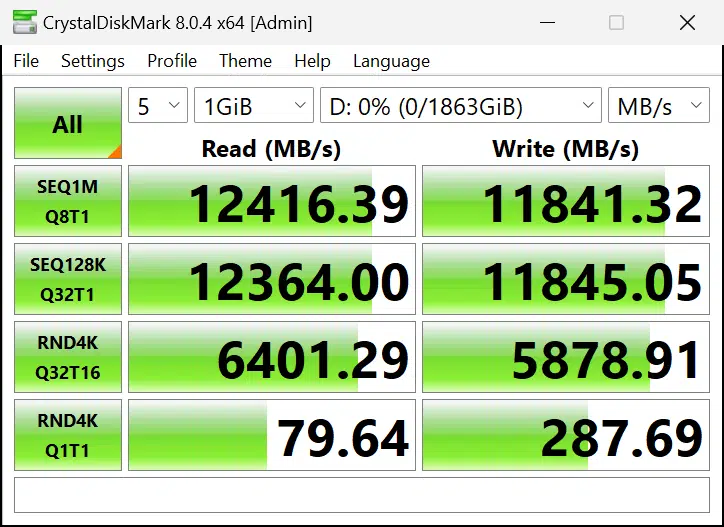
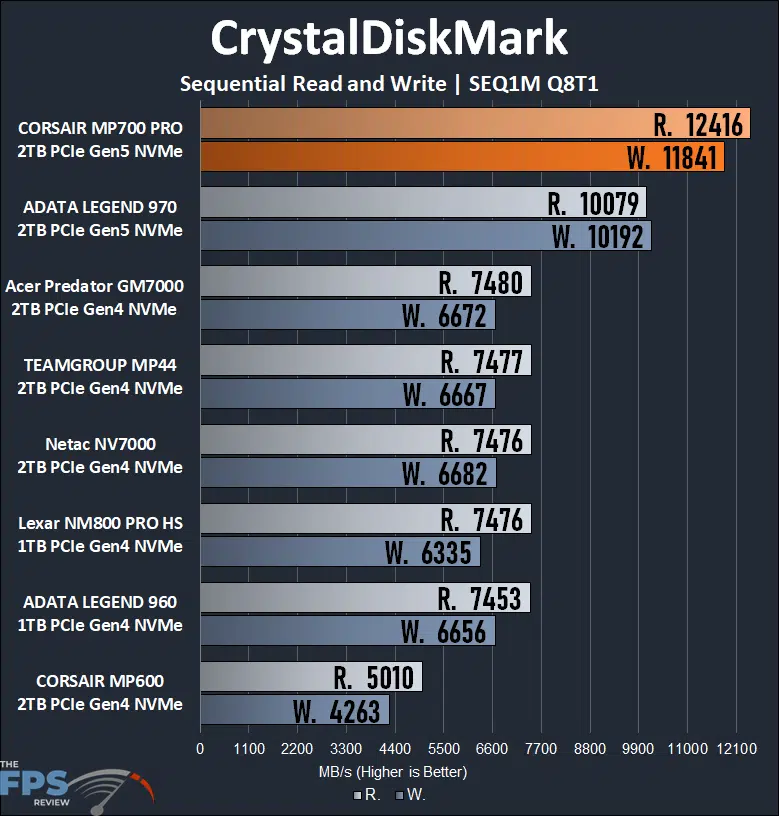
The rated sequential read speed on the CORSAIR MP700 PRO 2TB PCIe Gen5 SSD is 12,400 MB/s read and 11,800 MB/s write. In the SEQ1M Q8T1 test, we are perfectly hitting those quoted speeds by CORSAIR. The CORSAIR MP700 PRO 2TB PCIe Gen5 SSD is working as advertised, hitting 12,416 MB/s on read and 11,841 MB/s on write. This soars past the ADATA LEGEND 970, which was previously the fastest Gen5 SSD, but no longer. The CORSAIR MP700 PRO 2TB PCIe Gen5 SSD is more than 2,000 MB/s faster in read and 1,600 MB/s faster in write performance as well. The ADATA LEGEND 970 hits about 10GB/s but the CORSAIR MP700 PRO 2TB PCIe Gen5 SSD is able to hit up to 12GB/s, which is just incredible performance.
When you compare the CORSAIR MP700 PRO 2TB PCIe Gen5 SSD to the CORSAIR MP600 we can see that it jumps from just 5GB/s up to 12GB/s or 7,406 MB/s higher on read an increase of 148% read performance. On write performance, the CORSAIR MP700 PRO 2TB PCIe Gen5 SSD is 7,578 MB/s faster or 178% faster write performance! When we look at it compared to Gen4 SSD performance, it’s about 66% faster on read performance and 77% faster on write performance compared to the fastest Gen4 SSD here.
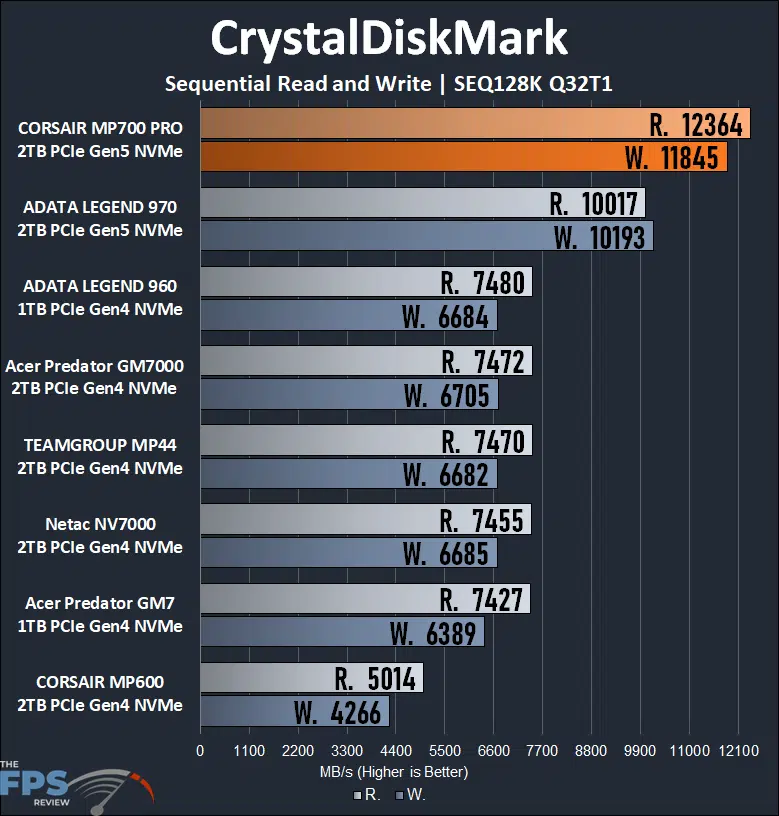
In SEQ128K Q32T1 the CORSAIR MP700 PRO 2TB PCIe Gen5 SSD is again at the top of its game, beating the ADATA LEGEND 970 quite well. It’s just way faster than the CORSAIR MP600, by a long shot, or any Gen4 SSD for that matter.
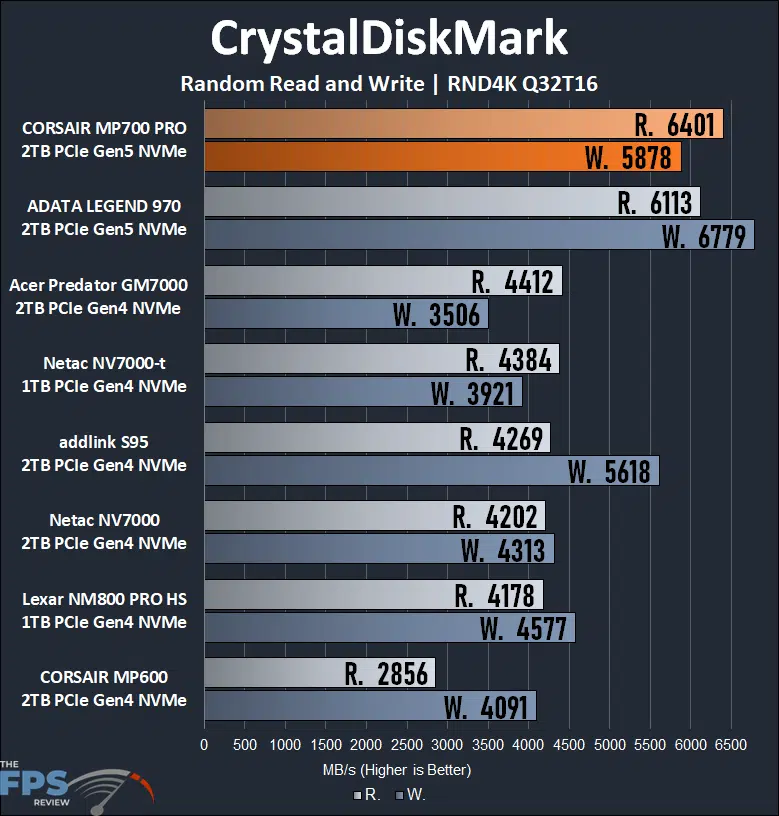
In RND4K Q32T16 performance the CORSAIR MP700 PRO 2TB PCIe Gen5 SSD also performs extremely well. It beats the ADATA LEGEND 970 on read performance by 5% but does come in quite under the ADATA LEGEND 970 on write performance. However, its write performance is still stronger than any other Gen4 SSD by a long shot. In read performance, it is 44% faster than the fastest Gen4 SSD, and in write performance it is 5% faster than the fastest Gen4 SSD, or 28% faster than the next fastest SSD. Compared to the CORSAIR MP600 the CORSAIR MP700 PRO 2TB PCIe Gen5 SSD is 124% faster on read performance and 44% faster on write performance.
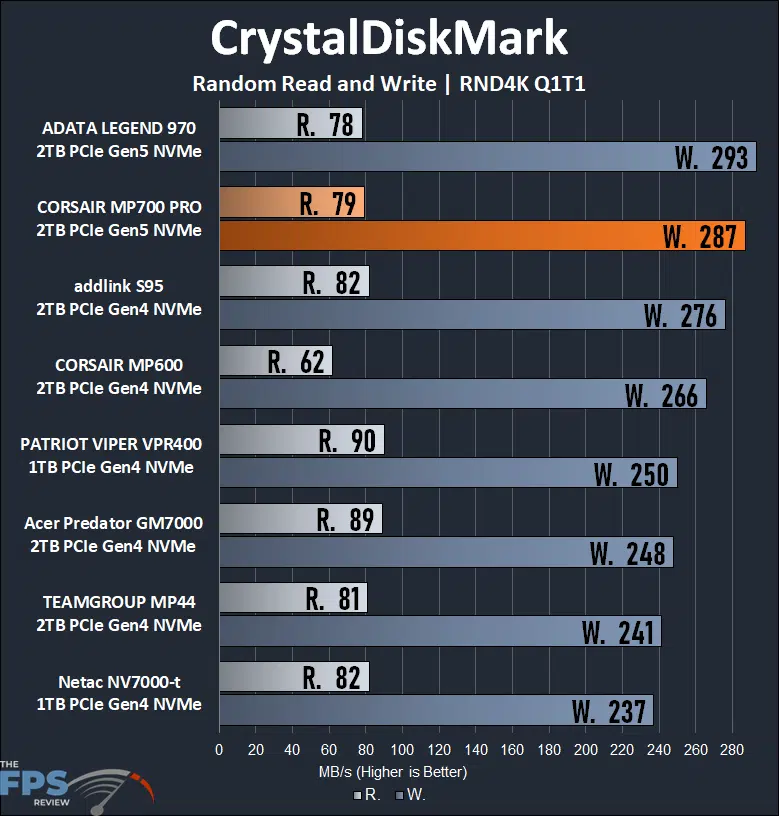
In RND4K Q1T1 performance, the CORSAIR MP700 PRO 2TB PCIe Gen5 SSD is at the top of its game in write performance for this random task. The ADATA LEGEND 970 is very strong here as well and does beat the CORSAIR MP700 PRO 2TB PCIe Gen5 SSD slightly by 2%, but compared to the rest of the SSDs the CORSAIR MP700 PRO 2TB PCIe Gen5 SSD is much faster than them. On read performance, it’s about the same as the ADATA LEGEND 970, just 1MB/s better. When we compare the CORSAIR MP700 PRO 2TB PCIe Gen5 SSD to the MP600 we find the CORSAIR MP700 PRO 2TB PCIe Gen5 SSD is 8% faster on write performance and 27% faster on read performance. Random is tough, but these results show at the end of the day that the CORSAIR MP700 PRO 2TB PCIe Gen5 SSD is a top performer in these types of workloads, and is able to perform better than last-generation drives.
Discussion (16 replies)
Join Discussion →I find it odd I guess that a PCIE 4 drive was able to come out on top in any metric. the Adata drive ruling the roost in professional applications.
You could buy 3 Gen 4 2TB drives for the price of this one drive and not need to worry about cooling.
Fast but really pricy.
It's all about the IOPS.
For single user scenarios (like those of us buying for gaming machines), does anything matter besides Queue depth 1 and thread 1 and random access latency? PCMark 10 Average access time and Crystal Disk Random Read and Write Q1T1 seems to be the most important measurements.
Write endurance and both burst and sustained write speeds have their place as well, I'd think?
Burst and Sustained matter, but does Gen 4 vs Gen 5 matter much? 7.5GB /sec vs 12GB /sec is a difference that may not make a difference. If you're reading 1MB, the actual read is going to be around .0001s (100 micro seconds), which means the drive latency starts to become a very sizeable chunk of the transaction. For a typical game load, do we know what the average file size is? How often does the drive really get to stretch it's legs at 12GB /sec?
Agreed that write endurance is also important, but for a single user case on larger drive (say 2TB+) it might take months to years to get a single drive write. Depends on what you're doing with it. My 2TB 980 pro steam drive probably doesn't have a single complete drive write on it yet.
Main reason it makes a difference is that the CPU is operating on the scale of nanoseconds, relative to main memory. So faster sustained rates and/or lower access latency both help in their own ways, if a particular application is regularly reaching back to non-volatile storage.
Lets take 3 theoretical drives, using flash latencies from a google search of "Flash Read Latency".
Drive 1: Gen 3 drive of entirely low latency 3d SLC. 8 microsecond (us) read latency, 4,000MB /sec max transfer
Drive 2: Gen 4 drive of entirely 3d TLC. 75us read latency. 7,5000MB /sec max transfer
Drive 2: Gen 5 drive of entirely 3d QLC. 125us read latency. 12,000MB /sec max transfer
For a 4k file the drives will complete the operation in:
Drive 1: 108 us (8us latency, 100us transfer)
Drive 2: 128 us (75us latency, 53us transfer
Drive 3: 158us (125us latency, 33us transfer)
for a 1MB file:
Drive 1: 258 us (8us latency, 250us transfer)
Drive 2: 208 us (75us latency, 133us transfer
Drive 3: 208us (125us latency, 83us transfer)
For a 10MB file
Drive 1: 2508 us (8us latency, 2500us transfer)
Drive 2: 1408 us (75us latency, 1333us transfer
Drive 3: 958us (125us latency, 833us transfer)
If we're dealing with mostly 4k files, we'd prefer the the Gen 3 drive.
If we're dealing with files >700k<=1MB or smaller, we'd prefer the Gen 4 drive (or maybe even the Gen 3 if we had some 4k files in there)
If we're dealing with files >1mb, we'd prefer the Gen 5 drive.
Now, back in the day of Anadtech's SSD articles (2009 ish), a huge portion of day to day usage was 4kb, especially for OS drives. If that's the case, and you cared about performance over space, you'd take the lower latency flash over the new generation of PCIE drives every day.
I would say one good gauge of that:
A system only has so much RAM and VRAM - loading files that total beyond the size of both of those capacities would be .. somewhat dubious. So, gigabytes would be reasonable assumption, tens of gigabytes plausible but your starting to stretch it, and once you are talking hundreds of gigabytes, well... install sizes aren't much larger than that and you'd have to be loading files multiples of times to hit that and your just doing something really wrong at that point.
So I think "short" sustained reads would be a good metric - say upwards of 100Gb... but on these drives that should only take a few seconds at best. In the real world, though, none of that is really going to be a sustained sequential read - games are usually made up of hundreds of small files, even if you are hitting a couple dozen GB total, that's split across hundreds of smaller files.
So looking at it another way:
Just an example - my secondary SSD currently has 173 GB worth of games installed across 11 titles. So that's an average of 15.7 GB per title. That doesn't sound too bad, fairly reasonable for an average. That 173 GB is split up across 20,350 files.... so each file is, again on average, 8 MB... (some dirty math there, 0.008 GB, which isn't exactly 8 MB, but ok). Many of those files will be very small, some will be much larger, but ... your still looking at touching a lot of small files during a game load. Even if you are doing something like a WAD or PAK, those are just compression methods and it's still going to read inside the file like an external file system.
Those are averages, but I would say it supports the point that latency means much more than sequential.
There was an article I read about one of these new drives, getting within 8 degrees of throttling just playing starfield using something like 2.4gb a second rather sustained.
Hmm, if they are warming up that fast even with the heatsink, might be time to go back to a case with a fan on the door again.
Edit
I also checked my steam drive. 10 games, 256GB, 142,780 files. That's 1.79MB average per file
The earlier numbers really show why I’m so frustrated with current “performance” drives. I really don’t need a 4tb drive for my game drive, and I don’t need a 1tb drive for my OS.
Instead of a 4tb TLC Samsung 990 pro, give me a 1.5 TB latency Optimized SLC gen 5 drive for games, and instead of 2TB 990 pro, give me a 768 GB latency Optimized Gen 5 drive for OS.
Heck, if all the better they could manage is 256GB SLC drives, give me 256GB SLC and 16GB DRAM cache and I’ll figure out how to use them … say raid 0
We get what's cost effective to be mass-produced - I know you know that, but that's why we get the kind of flash ICs and ultimately drives, same for DRAM ICs, and for no longer getting Optane ICs.
It’s not like SLC doesn’t exist anymore - it is being mass produced and used as cache paired with slower flash and is used in the enterprise for things like database flash cache.
To a certain degree, even if we don’t get the “good” stuff, TLC/QLC can be SLC if the controller just writes a single bit instead of 3/4 to the cell. Sure, it wouldn’t be latency optimized so it would be more like 25us, but given the option in Samsung magician I’d convert my drives to SLC.
I just find it hard to believe there isn’t a decent sized consumer market for pure SLC drives.
Windows 10 still runs fine enough off spinners if you're just doing office stuff...