
Synthetic System Benchmarks
On this page, we will show synthetic benchmarks, some that test a variety of system use-case scenarios, and others that test specific multi-core and single-core/thread workloads to hone in on performance differences. In all of our graphs to follow, the bars are arranged from the fastest MT/s speed down, so 8800MT/s is on top, with 7200MT/s on the bottom, and this arrangement is locked in independent of the performance shown; they are not arranged by result, but rather the DDR5 memory speed.
AIDA64
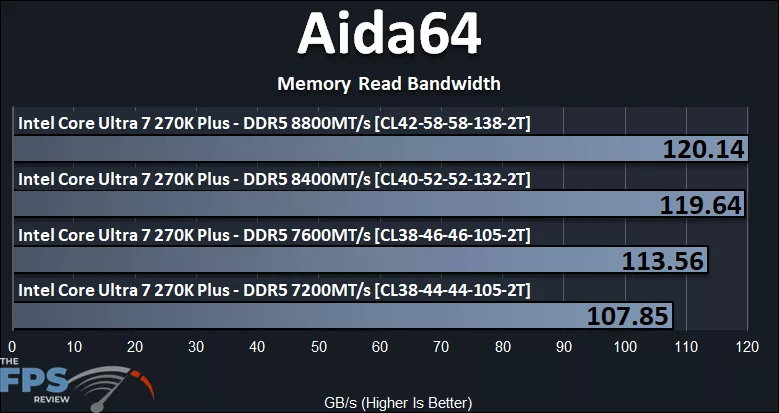
As one would expect in AIDA64’s memory read bandwidth testing, the DDR5 8800MT/s read performance result is the fastest at 120GB/s of bandwidth, with the 7200MT/s being the lowest at 107GB/s. From 7200MT/s up to 8800MT/s, the gain in raw read memory bandwidth is 11%. There is a gain from 7200MT/s to 7600MT/s and then to 8400MT/s, however there is a diminishing returns result moving up to 8800MT/s.
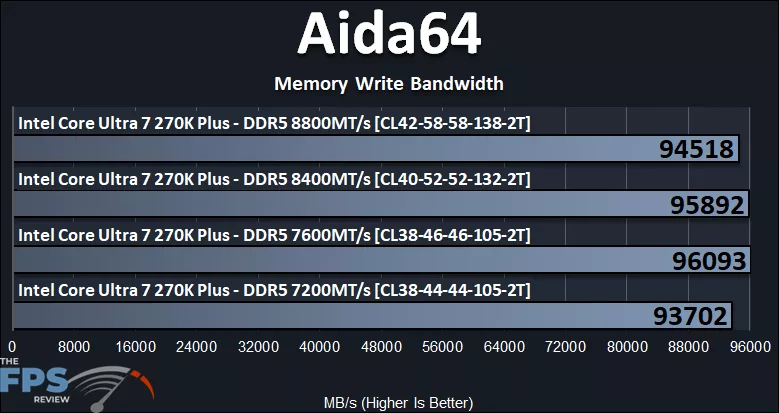
The same cannot be said about memory write bandwidth. Here, the timings seem to affect the result, and the higher timing memory is actually slower than the 7600MT/s profile, with the lower timings being actually the fastest result. The lowest result is the 7200MT/s profile; the difference between the lowest and highest result is only 3%, however, so we are talking very small margins for write bandwidth.
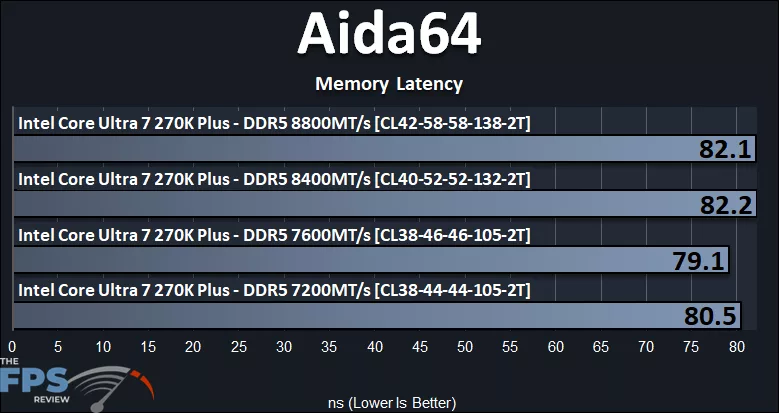
Importantly, we can see the effects that timings have with the higher transfer rate memory. The 8400MT/s and 8800MT/s CUDIMM memory, with the highest timings, have the highest latency of 82ns. The best result is actually the 7600MT/s DDR5 UDIMM at 79ns, and this backs up many of the other results you’ll see in our testing today.
3DMark CPU Profile
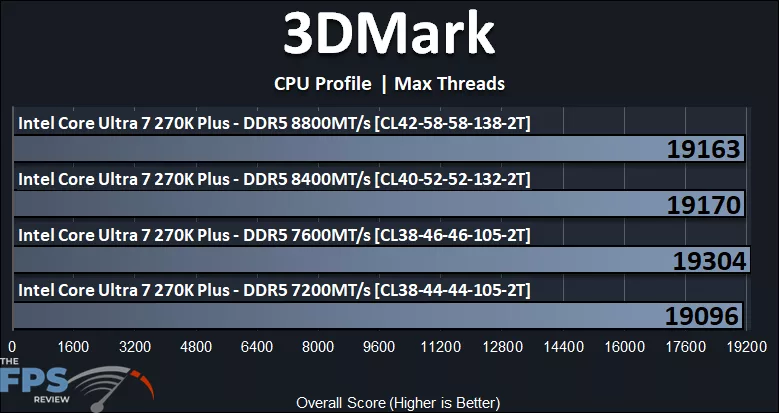
In 3DMark’s CPU Profile test, we are testing the Max Threads CPU performance. The different speed memory does actually cause a different result, and we can see that the 7600MT/s memory with its timings actually yields the highest result. The 8400MT/s and 8800MT/s CUDIMM memory runs slightly faster than the 7200MT/s UDIMM, but slower than the 7600MT/s. Overall, though, we are talking peanuts here; the difference between the highest and lowest performance result is only 1%.
Geekbench 6.7
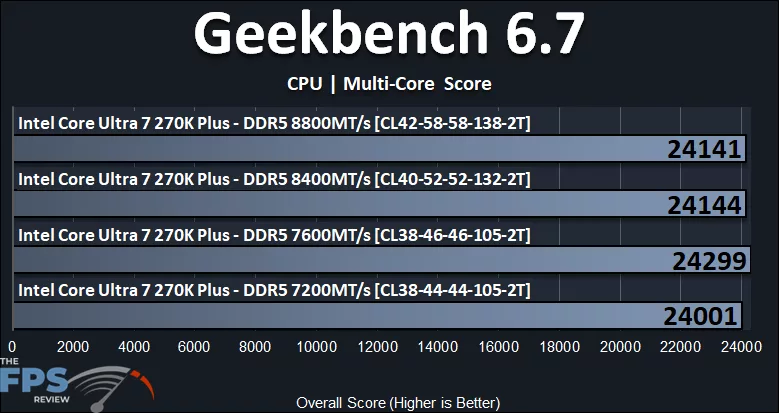
In Geekbench 6.7, we are starting to see a trend with the 7600MT/s UDIMM memory at CL38, as it provides the highest performance result. The 8400MT/s and 8800MT/s sit slightly above 7200MT/s, but under 7600MT/s with their higher timings. Once again, the overall difference is small, with a 1% difference from the smallest result to the highest.
PassMark PerformanceTEST
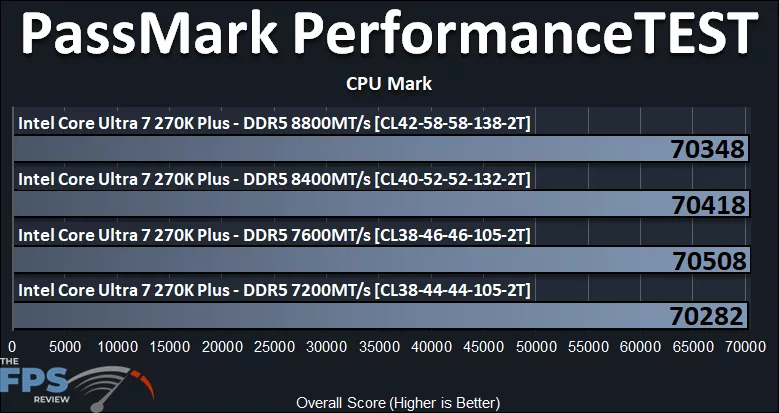
In PassMark PerformanceTEST, the performance is grouped even more tightly together, with no real discernible differences at all between the data. I guess technically, the 7600MT/s UDIMM memory at CL38 is technically the fastest.
Discussion (12 replies)
Join Discussion →Pretty much what I expected to see to be honest.
Try buying some???
Need a loan.....LoL
Would have been interesting to have some "run of the mill" 6000MT/s RAM like alot of folks use (because its affordable) to compare as a baseline......?
Some serious hot deals on Arrow plus combos right now. AIOs, Lego Batman, PSUs, boards. Also, 270K is below MSRP and the second best seller on Amazon today. Been a long time since a Intel CPU cracked the top 5.
Just wanted to point out that actual overclockers may take offense at there being no information available on the values for NGU, D2D and Ring. If those were kept at default then the memory overclocks are almost pointless due to there being a bottleneck in the flow of data between the CPU and RAM sticks. For anything over 8000 MT/s, NGU multiplier needs to be 34, D2D should ideally be 35 or higher and ring from 42 to 46 would be ideal. It's unfortunate that Intel did not make it so that these values are optimized automatically as RAM speed is increased.
My own 245KF was able to do NGU 34, D2D 35 (latest BIOS kept it at 30 despite setting a higher value) and ring 42. Sadly, the CPU is out of the socket of the mobo as I was trying to sell it so any benchmark data I have is inaccessible at the moment unfortunately.
Regarding the RAM timings, the sticks should be able to 7200C34 and 7600C36. The 8000+ timings seem to be ok.
Just did a web search on this, have yet to find a review that did the NGU/D2D/Ring overclocking, ect. Currently have my 265KF at 70.1ns latency. Wondering if 270K can get it any lower, or if I should even waste the $$?
The only low latency Arrow Lake champ right now is 250K/KF.
You may gain ~10 fps plus future APO/iBOT game/application support with 250KF.
There's unfortunately a rather glaring problem with the testing here which is comparing a kit using 16GB modules to one using 24GB. Subtimings are important and almost every single higher capacity module has higher cell refresh timings than an equivalent speed/primary latency lower capacity. That is absolutely the case here which throws off the results and in turn the conclusion. If one is trying to compare speed and primary timings the kit capacities really need to be the same.
What kinda latency are you getting with your setup??
y-cruncher score comparison 6000C42 vs. 8200C38 (NGU is 32 or 34, D2D is above 30 and Ring is 42)
6000C42:
8200C38:
Another multicore scaling benchmark here: https://forums.anandtech.com/threads/arrow-lake-builders-thread.2622775/post-41610100
I haven't really done a lot of optimization as real life kept getting in the way. I did replace a 265K with the 270K Plus and they both performed within margin of error of each other when it came to latency using the same settings. I imagine best case scenario for latency with ARL is going to be based on bins more than SKU.
From what little tweaking I've done NGU seems to make a lot less difference than D2D. Subtimings on memory can also make a pretty big difference. The board I'm using has had some weird issues with DRAM timings so once I found stable numbers I just left it, but this is high up on my list for when I get time.
Skatterbencher puts out my favorite writeups (and also has videos) for CPU tweaking: https://skatterbencher.com/2025/06/18/skatterbencher-87-core-ultra-7-265k-overclocked-to-5700-mhz/
They've done more recent ones with the 270/250 as well.
Ok, upgraded to a 270k, and another new motherboard, since I bent socket pins (Rookie move, first time ever...) Proc clocks almost exactly like my 265KF, 56P core, 49 E core (265KF was 56/50. 41 cache, 33 NGU/D2D, Running 48gb Kingston Renegade 8400 @ 38-49-49-56 timings, same 71.3 ms latency as with 265KF as well. Seems to run cooler, and extra 4 cores. XTU benchmark went up nicely, as well as my 3DMark bench's. Have yet to run PCMark bench yet. All in all, runs well in a dead end platform, should keep me happy for @ least 4 yrs i'd hope.