
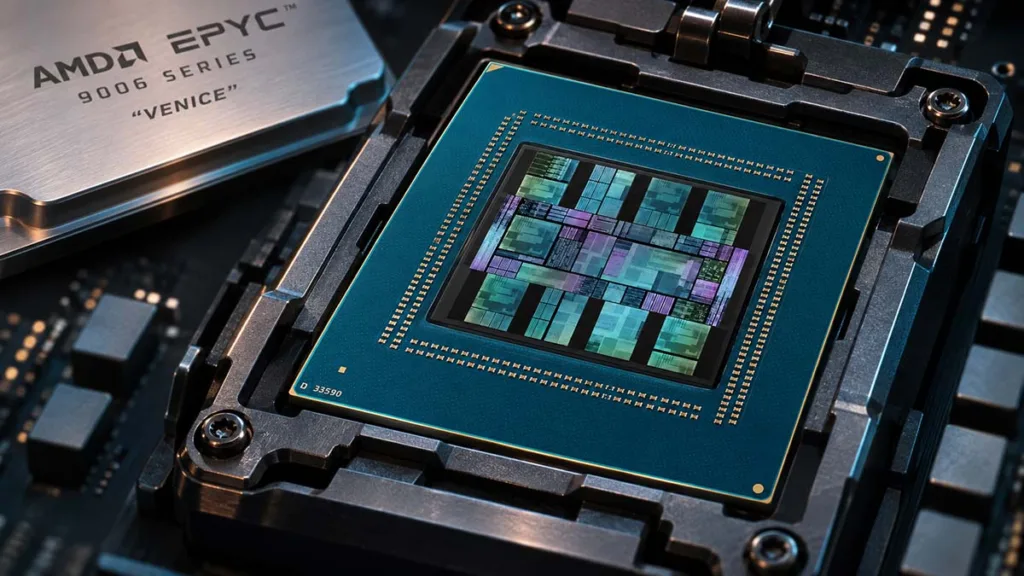
Zen 6 finally has independent numbers attached to it. They come from the server side, but the core-complex changes in AMD’s EPYC Venice say a lot about where Ryzen goes next. Elsewhere, NZXT’s H7, H5, Kraken, and C-series refresh hit review embargo, along with a pile of panoramic cases and PSUs.
Before we get started, I want to share with you a picture of the happiest woman that I saw at Computex 2025 (who had her $3k handbag signed by Jensen while I watched).

AMD EPYC 9006 “Venice” (Zen 6)
Written reviews:
- Phoronix: https://www.phoronix.com/review/amd-venice-nvidia-vera
- ServeTheHome: https://www.servethehome.com/amd-epyc-9006-results-are-here-and-amd-delivers-a-knockout-part-deux/
- StorageReview: https://www.storagereview.com/review/amd-epyc-venice-sp7-review
Consensus summary: ServeTheHome and StorageReview frame Venice as a big step over Turin. The flagship EPYC 9996 carries 256 cores, a third more than Turin. The standard Zen 6 CCD grows from eight cores to twelve, and AMD lists a 5.3GHz maximum boost, up from 5.0GHz on Zen 5. On memory bandwidth, StorageReview measured STREAM Triad at 1.9x the Turin flagship on DDR5-8000 and 3.0x with MRDIMM-12800. In Phoronix’s HPC geomean against NVIDIA’s Vera, the 256-core 9996 came out 1.18x faster and the high-frequency 9686F 1.13x faster. Venice drew more power than Vera but generally delivered better performance per watt.
FPS Review take: This is a server launch, but the 12-core Zen 6 CCD is what desktop builders should watch, as we noted in our EPYC Venice and Zen 6 architecture breakdown. Whether AMD brings that layout to Ryzen will decide if Zen 6 desktop chips are a bigger jump than our Zen 4 vs Zen 5 Ryzen 7 retest found for the current generation.
AMD Ryzen 9 9950X vs Ryzen 9 9900X
Written reviews:
- The FPS Review: https://www.thefpsreview.com/2026/11/11/amd-ryzen-9-9950x-vs-ryzen-9-9900x-cpu-review/
Consensus summary: Two years after launch, our refreshed testing across 12 games found the 16-core 9950X ahead in nearly every title. The margins were usually only 1 to 3 percent, but they reached 6 percent in average framerate and up to 13 percent in 1% lows in Crimson Desert. In fully multi-threaded work, the 9950X delivered up to 24 percent more performance, at higher power draw. Single-thread results were essentially even.
FPS Review take: With a fast GPU, the 9950X squeezes out a little more, especially in 1% lows. For a mid-range build, the 9900X gives up little in games and saves money and watts. If gaming is the priority, our Ryzen 9 9900X3D vs 9950X3D review covers the cache-heavy alternatives.
GIGABYTE Z890 AORUS ELITE X ICE
Written reviews:
- The FPS Review: https://www.thefpsreview.com/2026/11/09/gigabyte-z890-aorus-elite-x-ice-motherboard-review/
- FunkyKit: https://www.funkykit.com/reviews/motherboards/gigabyte-z890-aorus-elite-x-ice-motherboard/
Consensus summary: Our review found its performance equal to two identically outfitted Z890 boards and gave it an 8.9. Its standout feature is storage: five M.2 slots, one Gen5 x4 and four Gen4 x4. FunkyKit’s earlier launch-era review called it one of the first all-white Z890 boards and recommended it for white Arrow Lake builds.
FPS Review take: All Z890 boards perform about the same in benchmarks, so this one comes down to the white finish and the M.2 count. Compare it with our MSI MAG Z890 TOMAHAWK WiFi II review if you don’t need an all-white build.
NZXT Kraken Core 360 (2026)
Written reviews:
Consensus summary: Guru3D found that NZXT’s stripped-down 2026 Kraken Core, built around Asetek’s Gen 9V pump, holds up well under load. A Core i9-12900K tuned to 288W topped out at 80°C, and a Ryzen 7 9700X hit 58°C at default settings. Noise stayed around 30 to 31 dBA under normal loads and 34 dBA at the highest Intel tuning point. The trade-offs are deliberate: a slim 27mm radiator, a single-frame fan assembly that makes swapping one fan harder, and no RGB, LCD, or coolant-temperature readout. At $79.99 with a six-year warranty, Guru3D gave it a positive recommendation.
FPS Review take: Software-free, single-cable cooling at $79.99 is the kind of back-to-basics AIO we’d like to see more of. Its 288W results are good enough that it isn’t only for mid-range chips.
NZXT H7 RGB+ and H5 (2026)
Written reviews:
- TweakTown: https://www.tweaktown.com/reviews/11667/nzxt-h7-rgb-plus-full-tower-chassis/index.html
- Club386: https://www.club386.com/nzxt-h5-rgb-review/
- Guru3D: https://www.guru3d.com/review/nzxt-h7-rgb-plus-2026-review/
- TechPowerUp: https://www.techpowerup.com/review/nzxt-h7-rgb/
- TechPowerUp: https://www.techpowerup.com/review/nzxt-h5/
Video reviews:
- Techtesters: https://www.youtube.com/watch?v=q7_FvqrXqHY
- Hardware Canucks: https://www.youtube.com/watch?v=N8tNUF8M7uU
- MT High-Tech: https://www.youtube.com/watch?v=XQfKvR3BIdw
Consensus summary: Both cases use one curved glass panel across the front and side, and reviewers mostly agree it looks fantastic. TweakTown notes that the larger H7 drops support for oversized motherboards and uses its space for three 420mm radiator mounts. Club386 liked the H5 RGB+’s glass roof but said it shows smudges easily. It also found that value skews heavily toward the RGB+ model over the fanless base H5. The H7 lists at $159.99, and the H7 RGB+ at $259.99.
FPS Review take: NZXT has caught up with the panoramic-case trend instead of setting it. The H5 RGB+ looks like the better value of the two, while the H7 makes sense mainly for builders who want 420mm radiators.
Montech King 95 3D Pro
Written reviews:
- Tom’s Hardware: https://www.tomshardware.com/pc-components/pc-cases/montech-king-95-3d-pro-case-review
- TweakTown: https://www.tweaktown.com/reviews/11666/montech-king-95-3d-pro-chassis/index.html
- KitGuru: https://www.kitguru.net/components/cases/leo-waldock/montech-king-95-3d-pro-review-a-huge-update/
- TechPowerUp: https://www.techpowerup.com/review/montech-king-95-3d-pro/
Video reviews:
KitGuru: https://www.youtube.com/watch?v=nyaTs0oMF90
Consensus summary: Reviewers agree the King 95’s update, which adds a glass top panel, didn’t cost it any cooling. KitGuru had expected the extra glass to choke airflow and found it cooled well. TweakTown gave it an Editor’s Choice for cooling and ease of building. Tom’s Hardware’s one complaint was that the seven included Link fans on the Pro version get noisy at full speed, though it called the $119.90 base and $199.90 Pro prices an excellent update. TechPowerUp highlighted rear-connector motherboard support and generous clearances at a competitive price.
FPS Review take: Montech keeps undercutting bigger brands on panoramic cases, and the seven bundled fans make the Pro a good deal. Plan on setting a fan curve.
Antec C6 Curve Air
Written reviews:
- PC Gamer: https://www.pcgamer.com/hardware/pc-cases/antec-c6-curve-air-review/
- eTeknix: https://www.eteknix.com/antec-c6-curve-air-mid-tower-case-review/
Consensus summary: PC Gamer scored it 91 percent and suggested it might be the best case of 2026. It praised the looks, the cable management, and a build experience it said beats some bigger case makers. It also noted ample ventilation along the sides and base. An earlier review from eTeknix covered the curved glass and the airflow from the shroud-mounted intake fans.
FPS Review take: Most curved-glass cases charge a premium for the look, so a budget one getting this kind of praise is notable. If your build doesn’t need a vertical GPU mount, it’s worth a close look.
MSI MEG Maestro 900R
Written reviews:
- PC Gamer: https://www.pcgamer.com/hardware/pc-cases/msi-maestro-900r-review/
- Club386: https://www.club386.com/msi-meg-maestro-900r-review/
- OC3D: https://overclock3d.net/reviews/cases_cooling/msi-meg-maestro-900r-pc-case-review/
- ThinkComputers: https://www.thinkcomputers.org/msi-meg-maestro-900r-pc-case-review/
Consensus summary: Everyone loves the removable, rotatable central motherboard tray, which ThinkComputers and PC Gamer both said makes the early build stages easy. The reviews diverge once the build is finished. PC Gamer scored it 71 percent, saying some parts don’t feel premium and that the price and glass panels are barriers. OC3D said it felt unfinished, and Club386 called its size, weight, and cost impossible to ignore.
FPS Review take: A flagship showpiece case should feel as good in the build as it looks on the desk. The removable tray is clever enough that we hope MSI keeps it and fixes the rest in a cheaper follow-up.
NZXT C1200 Platinum / C1000 Platinum
Written reviews:
- HWBusters: https://hwbusters.com/psus/nzxt-c1200-platinum-atx-v3-1-psu-review/
- TechPowerUp: https://www.techpowerup.com/review/nzxt-c1200-platinum/
- Guru3D: https://www.guru3d.com/review/nzxt-c1000-platinum-2026-psu-review/
Video reviews:
- Hardware Busters: https://www.youtube.com/watch?v=t4eruUZdeLo
Consensus summary: The C1200 Platinum is efficient and quiet but disappointed in HWBusters’ full test suite. It finished 24th of 29 units at 115V, well behind NZXT’s own Gold-rated C1200. Weak 12V transient response and high ripple were the main reasons. At $199.99, it costs more than several 1200W units that performed better overall. Guru3D’s C1000 Platinum review covers the smaller 1000W model, which shares the native 600W 12V-2×6 cable and ten-year warranty (Ed: What’s up with all the NXZT coverage this week?).
FPS Review take: Platinum on the label doesn’t mean a better PSU. Here the cheaper Gold sibling is the one we’d buy.
Corsair HX1000i SHIFT CRYSTAL
Written reviews:
- Tom’s Hardware: https://www.tomshardware.com/pc-components/power-supplies/corsair-hx1000i-shift-crystal-power-supply-review
- TechPowerUp: https://www.techpowerup.com/review/corsair-hx1000i-shift-crystal/
- KitGuru: https://www.kitguru.net/components/power-supplies/zardon/corsair-h1000i-shift-crystal-psu-2026-review/
Video reviews:
- Hardware Busters: https://www.youtube.com/watch?v=PAdBM-PdMD8
- Bastel Nerd: https://www.youtube.com/watch?v=TZjNUV_kHh8
Consensus summary: Tom’s Hardware found the clear-panel SHIFT is more than a looker. Efficiency averaged 92.1 percent at 230V, the fan stayed off up to half load, and it lost almost nothing in a 45°C hotbox. Its listed compromises were Taiwanese capacitors, more noise in the hot test, and a 200mm-long chassis. Corsair says it is its first PSU with active per-pin overcurrent protection on the 12V-2×6 connector via PinProtect+.
FPS Review take: The see-through panels are a gimmick. Per-pin current monitoring is not, and it’s the feature that should spread to the rest of Corsair’s lineup.
Gigabyte UD850GM PG5 V2 (2026)
Written reviews:
KitGuru: https://www.kitguru.net/components/power-supplies/zardon/gigabyte-ud850gm-pg5-v2-2026-psu-review/
Consensus summary: KitGuru went in with reservations about another Gigabyte PSU and came away moderately impressed. It found very good load regulation, ripple peaking at 27mV on the 12V rail, and efficiency of 92.3 percent at 450W, falling to 88.4 percent at full load. At around £90, KitGuru said it is worth considering despite some faults.
FPS Review take: It’s a solid budget 850W option, though not one to buy without comparing current prices against established mid-range units.
Discussion
Join Discussion →No replies yet. Be the first to reply on the forum.