
Gameplay Performance – DLSS 3 vs DLSS 4 Latency
*Take Note* – The performance shown below is not FPS, it is in fact PC Latency represented in milliseconds. We utilized NVIDIA FrameView to capture statistics while playing these games, and are showing the AvgPCLatency and MaxPCLatency results as indicated by NVIDIA FrameView data. For Latency, the lower the number, the better. Therefore, we are showing the MaxPCLatency which shows the highest latency number achieved in the run-through, which would be a “bad” result, you really want the Max Latency to be as low as it can be for the best experience while gaming.
In a similar vein to what we did above, we are also looking at PC Latency below, but now we are going to directly compare DLSS 3’s latency to DLSS 4’s latency on the NVIDIA GeForce RTX 5090 FE video card. In Alan Wake 2, we have the ability to show two versions of the game, in one version only DLSS 3 is supported, and so we have tested that on the GeForce RTX 5090, and then in a beta dev version NVIDIA gave us access to, we can also test DLSS 4 on the GeForce RTX 5090. In this way, we can directly compare DLSS 4 Upscaling between DLSS 3 and DLSS 4, as well as Frame Generation between DLSS 3 and DLSS 4.
Alan Wake 2 – 4K
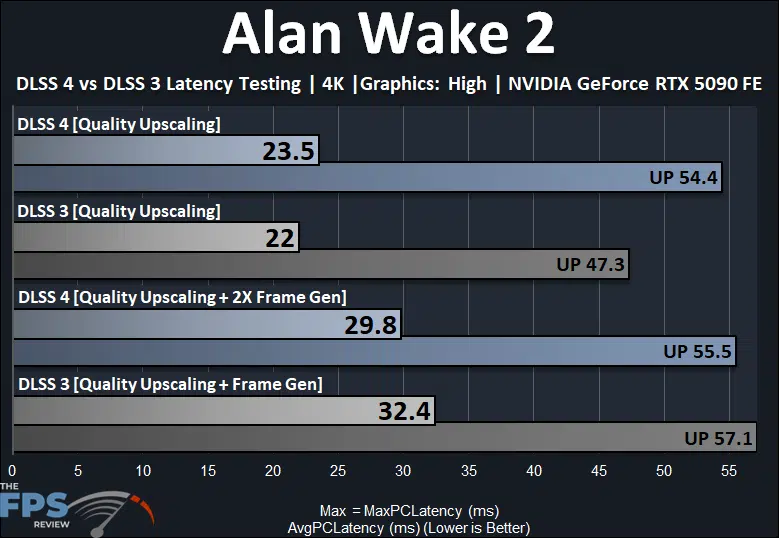
In Alan Wake 2, we are running at 4K with “High” preset on the NVIDIA GeForce RTX 5090 FE. We are directly comparing DLSS 3 Upscaling versus DLSS 4 Upscaling, as well as DLSS 3 Frame Generation versus DLSS 4 2x Frame Generation. The numbers on the graph are latency, in milliseconds, lower is better. Right off the bat, it seems DLSS 4 Upscaling has an increased latency over DLSS 3 Upscaling in this title. We see the average latency and especially the max latency, increase with DLSS 4 versus DLSS 3 on the Upscaling component. The average isn’t too far off, but it’s the max latency that will effect the experience the most.
When we look at Frame Generation, we find that there is actually a decrease in latency with DLSS 4 Frame Generation on the average and the max. Therefore, it seems latency is a bit lower with DLSS 4 2x Frame Gen versus DLSS 3 Frame Gen on the RTX 5090, which is positive. It’s just very interesting that the DLSS Upscaler part has an increased latency, perhaps the new Transformer Model causes a bit more latency than the CNN model?
Alan Wake 2 – 4K RT
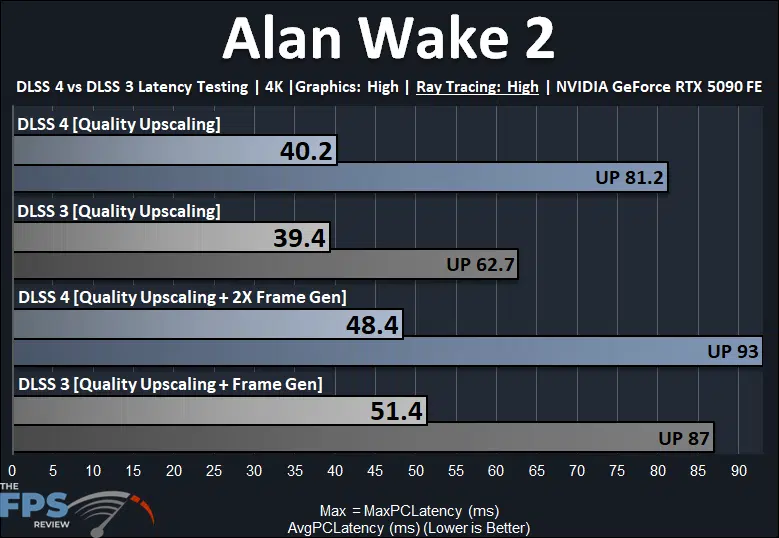
In the graph above, we are now running Alan Wake 2 at 4K with “High” Ray Tracing enabled, this really tests the RTX 5090 because the framerates are much lower here. When we enable DLSS 4 Upscaling we once again see a pretty big increase in latency over DLSS 3 Upscaling. This is quite a bit exaggerated with the maximum latency here at 81ms with DLSS 4 Upscaling versus 62ms with DLSS 3 Upscaling. Once again, perhaps the Transformer Model has more latency than the CNN model?
When we look at Frame Generation, it is quite interesting, DLSS 4 Frame Generation has a lower average than DLSS 3 Frame Generation, but a much higher maximum. That is different than what we experienced without Ray Tracing, but here, it seems the new DLSS 4 Frame Generation causes a slightly higher maximum latency when the framerates are low.
Alan Wake 2 – 1440p RT
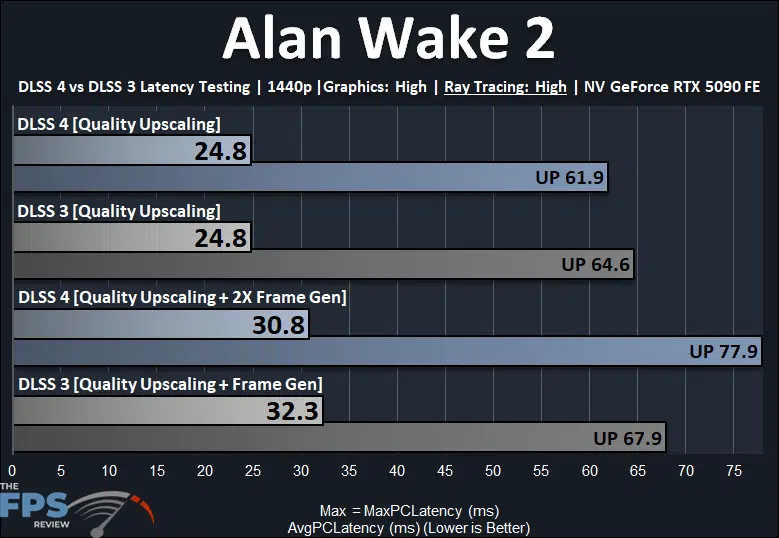
Just to be thorough, we also tested 1440p with “High” Ray Tracing enabled on the NVIDIA GeForce RTX 5090 FE. At this lower resolution, now the DLSS 4 Upscaling and DLSS 3 Upscaling latency is pretty much the same, so there seems to be no difference at this lower resolution. However, we see once again that with Ray Tracing enabled the Frame Generation is slightly higher with DLSS 4 Frame Generation over DLSS 3 Frame Generation. The average is slightly lower, but the maximum latency increases quite a bit, oddly.
Discussion (19 replies)
Join Discussion →A lot to unpack indeed. I'll be re-reading this review a few times, at least. Thanks @Brent_Justice !
Me too, me too, it's a long one boys! I attempted to include some relevant topics and testing, considering the new technologies. It's just the tip of the iceberg on potential testing. Frame Generation is one of the hardest things to convey.
Nice review I love it . THANK YOU!
Seems to be getting the 9950x3d will be wise for this one... It's been a long time since we've seen a new video card need more than the current gaming champ CPU can push.
Were you all seeing utilization less than 100% in the video card when you called that out?
Is reflex enabled on the native 4k latency tests? they seem quite high.
Except that an AMD exec was quoted a few days ago as saying the performance will more or less be the same. AMD needs to make a CCD with more cores/threads, that or really bump up the clock speeds, or both.
BTW the card kind of looks somewhat small.
That's the magic in their engineering.. It looks like a great card, in that small(ish) footprint..
Do you notice any IQ difference between DLSS4 and DLSS 3? DLSS is supposed to have better IQ
I don't really see a reason it's not somewhat shorter. Pretty much all 3rd party cards I've seen look gargantuan.
Watch the gamers nexus video on the cooling. They are the only source that go's into it and it's actually VERY interesting. That card is engineered very well... from a cooling perspective and density perspective.
Higher density = lower cost because less materials for PCB, but more cost in the cooler itself that was engineered very well by all appearances to be minimal on materials to effectiveness. So in effect they spent a lot to engineer the board but it will pay off in dividends on production costs needing less materials. :)
Really like the angled 12V-2x6 port. Makes so much more sense than previous ports on FE and custom cards.
As much as I want one with an AIO I'm seriously considering this FE version. I normally don't care about FE models but really liking this one. I'll probably still try to get an custom with AIO (MSI more than likely) but feeling tempted by this one.
since nvidia claims the RTX5070 beats the RTX 4090, wouldn't it be fair to claim that the RTX4090 is faster than the RTX5090 (when using dlss 3.5 frame generation vs no frame gen)? :p ;):rolleyes: