
Conclusion
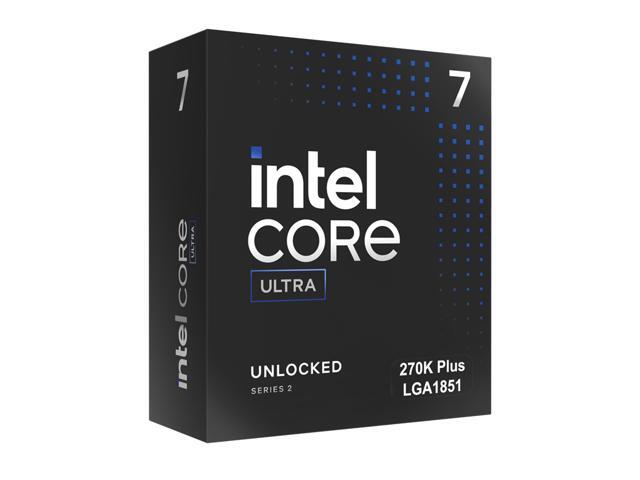
In our Intel Core Ultra 7 270K Plus versus Intel Core Ultra 9 285K CPU Performance Review, we benchmarked both CPUs to find out if the Intel Core Ultra 7 270K Plus is a 285K killer. Since both the Intel Core Ultra 7 270K Plus and Intel Core Ultra 9 285K have the same core configuration, and the same thread count, with only some frequency differences between them, we wanted ot know if the Intel Core Ultra 7 270K Plus is a cheaper replacement for the Intel Core Ultra 9 285K.
The new Intel Core Ultra 200S Plus desktop CPU series was launched in March, 2026 and represents a refresh of the current Arrow Lake architecture, based on the same Socket LGA1851 platform and motherboards. For $299 MSRP, the Intel Core Ultra 7 270K Plus has been launched at a very competitive price point. The Intel Core Ultra 9 285K was launched in October 2024 at a $549 MSRP. The Intel Core Ultra 7 270K Plus brings some refreshes to the existing architecture, including upgrades in terms of Die-to-Die frequency, 4 extra E-Cores, more Cache, and the new Intel Binary Optimization Tool. This then aligns the Intel Core Ultra 7 270K Plus with the Intel Core Ultra 9 285K in terms of 8 P-Cores and 16 E-Cores.
We therefore wanted to find out if the Intel Core Ultra 7 270K Plus is really a replacement for the Intel Core Ultra 9 285K at a lower price. How would it perform in multi-threading, or single-threading/single-core performance? How would it perform in games? It does have a higher internal frequency, such as the +900MHz die-to-die frequency increase. Will all this rub off on gaming performance? Those are the questions we wanted to answer in our Intel Core Ultra 7 270K Plus vs Intel Core Ultra 9 285K Review. We ran the Intel Core Ultra 7 270K Plus and Intel Core Ultra 9 285K in several application-focused, synthetic benchmarks, as well as 14 modern games, with some new releases including Crimson Desert and Resident Evil Requiem.
Synthetic Performance
Let’s start with the multi-threading, IPC, and synthetic benchmark testing first. One of the key new features of this refresh is the addition of 4 more E-Cores, and of course, the clock speed differences internally. Since the architecture remains the same, IPC should be similar, save for clock speed differences; most benefit should be from the E-Cores or clock speed differences. The Intel Core Ultra 7 270K Plus and Intel Core Ultra 9 285K match in terms of core and thread count, with only internal frequency and E-Core frequency slightly different between them.
What’s pretty amazing is how the Intel Core Ultra 7 270K Plus compares to the Intel Core Ultra 9 285K in multi-threading application performance. The Intel Core Ultra 7 270K Plus is actually just as fast, if not a margin of 1% on average faster than the Intel Core Ultra 9 285K in multi-threading. In fact, in Cinebench 2026, the Intel Core Ultra 7 270K Plus was as much as 5% faster than the Intel Core Ultra 9 285K.
This all comes down to the higher boost of the E-Cores on the Intel Core Ultra 7 270K Plus, plus the internal die-to-die frequency improvements. When it comes to applications that demand all the cores, the Intel Core Ultra 7 270K Plus can pull through with slightly better performance over the Intel Core Ultra 9 285K, even though they both have the same thread count and the same architecture.
When it comes to single-thread or single-core performance, it can shift either way. Sometimes the benefit of the higher boost clock on the Intel Core Ultra 9 285K comes through, and offers a few percentage points of performance faster than the Intel Core Ultra 7 270K Plus. However, in apps that are more sensitive to those internal die-to-die frequencies, the Intel Core Ultra 7 270K Plus can pull ahead of the Intel Core Ultra 9 285K slightly.
Overall, one can really say the Intel Core Ultra 7 270K Plus and Intel Core Ultra 9 285K are so close in performance that they are practically the same in terms of content creation, multi-threading, and business applications. This means the Intel Core Ultra 7 270K Plus performs just as well as the Intel Core Ultra 9 285K in all system applications; they are ‘the same’ performance, yet the Intel Core Ultra 7 270K Plus has a lower price point.
Gaming Performance
We really wanted to put the Intel Core Ultra 7 270K Plus through its paces in games, and make sure to test out as many as we could squeeze in, and try to get some newly released games in there as well. We tested 14 games at 1080p to test in a CPU-dependent scenario since we are testing CPU performance, not GPU performance. We used a GeForce RTX 5090 to give the Intel Core Ultra 7 270K Plus as much headroom as we could to achieve all the framerates it can achieve, and see how much faster in framerate it allows over the Intel Core Ultra 9 285K.
What can we say, except that we were pleasantly surprised to find the Intel Core Ultra 7 270K Plus actually performs faster than the Intel Core Ultra 9 285K in gaming performance. The Intel Core Ultra 7 270K Plus was consistently faster in the AVG FPS, sure it may be 1%-3% on average, for the average FPS. However, this is consistently ‘higher’, not slower.
What was more impressive were the 1% Low improvements. Compared to the average framerate, it was the 1% Lows where the Intel Core Ultra 7 270K Plus really improved over the Intel Core Ultra 9 285K. The 1% Lows had a higher percentage of improvement than the average FPS in games. This really helps the gameplay experience.
We also saw some games that had greater average improvements, around 6% or so, like Cyberpunk 2077. This is because of the Intel Binary Optimization, which is working to improve performance on the Intel Core Ultra 7 270K Plus in this game. We also saw the maximum potential of this in Hogwarts Legacy, with the huge performance improvement. However, that was an outlier, and Intel Binary Optimization does require support per game in the tool software. At the very least, APO is supported in more games, and the Intel Core Ultra 7 270K Plus can benefit from that as well.
Overall, we can at least say the Intel Core Ultra 7 270K Plus matches the Intel Core Ultra 9 285K in gaming performance at its worst. However, most of the time, the Intel Core Ultra 7 270K Plus is actually going to edge out the Intel Core Ultra 9 285K in gaming performance, and the all important 1% Lows.
Final Points
I think we can definitely say that the Intel Core Ultra 7 270K Plus is a cheaper replacement for the Intel Core Ultra 9 285K in 2026. There is no advantage at all for purchasing the Intel Core Ultra 9 285K over the Intel Core Ultra 7 270K Plus.
The Intel Core Ultra 7 270K Plus has the same core configuration and the same thread count. In our multi-threading testing, our data revealed that the Intel Core Ultra 7 270K Plus can be slightly faster due to the faster E-Core clock speed and internal frequencies, despite the 285K’s technical boost advantage.
When it comes to the gaming performance of the Intel Core Ultra 7 270K Plus, it also exceeds that of the Intel Core Ultra 9 285K. The Intel Core Ultra 7 270K Plus offers a slightly AVG FPS advantage, and more importantly, 1% Low improvements that matter.
In terms of power and temperature, the Intel Core Ultra 7 270K Plus also exceeded expectations here as well. The Intel Core Ultra 7 270K Plus actually pulled less power in multi-threading, in an all-core workload, compared to the Intel Core Ultra 9 285K, and was only 2% higher power while gaming, which was at a reasonable power level. In terms of the temperature, the Intel Core Ultra 7 270K Plus actually ran cooler while gaming, and in multi-threading all-core workloads.
Finally, it’s the price. The MSRP of the Intel Core Ultra 7 270K Plus is $299, though current street pricing is higher. The Intel Core Ultra 7 270K Plus is actually available at the time of writing at around $349. This is still under that of the cost of a brand new Intel Core Ultra 9 285K, which is sitting around $557 right now online, and remember it launched at $589.
Basically, you can buy a CPU that slightly outpaces the Intel Core Ultra 9 285K in multi-threading and gaming for a 37% cheaper price now. That’s a real win on the Intel platform. If you were considering a Socket LGA1851 build, the Intel Core Ultra 7 270K Plus is the go-to CPU, full stop.



Discussion (1 reply)
Join Discussion →These cpus are an interesting play by Intel to try and claw back users. Good for them!!