
Gaming Performance (Dy-St)
In our game performance testing, we are utilizing an NVIDIA GeForce RTX 5090 FE video card. We are running each game at 1080p, Native Resolution, and we are using mostly the highest game settings. However, in Clair Obscur, we have lowered the game settings. We are using manual in-game run-throughs for each game and reporting the average FPS and 1% Lows. It is important to note the 1% Lows in many instances, especially in those where the AVG is close; the 1% Lows may not be. All games are running the latest versions. All graphs are organized from fastest to slowest.
Dying Light: The Beast
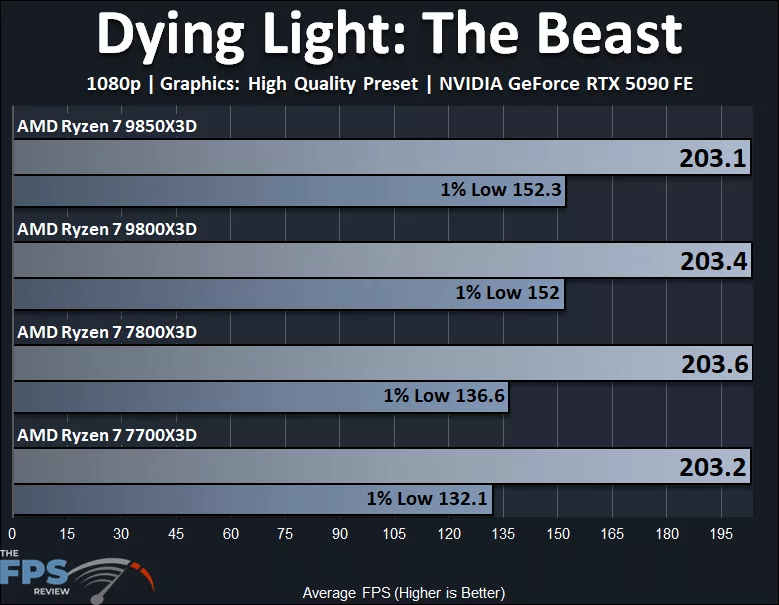
Dying Light: The Beast is another game where you must pay attention to the 1% Lows, as the averages are very close. If we compare by 1% Low performance, the Zen 5 X3D CPUs provide a very large performance improvement over Zen 4 X3D. The Ryzen 7 9800X3D is 11% faster than the Ryzen 7 7800X3D. The Ryzen 7 7800X3D is 3% faster than the Ryzen 7 7700X3D. The Ryzen 7 9850X3D has the same performance as the Ryzen 7 9800X3D. The Ryzen 7 9850X3D and Ryzen 7 9800X3D are 15% faster than the Ryzen 7 7700X3D.
Hogwarts Legacy
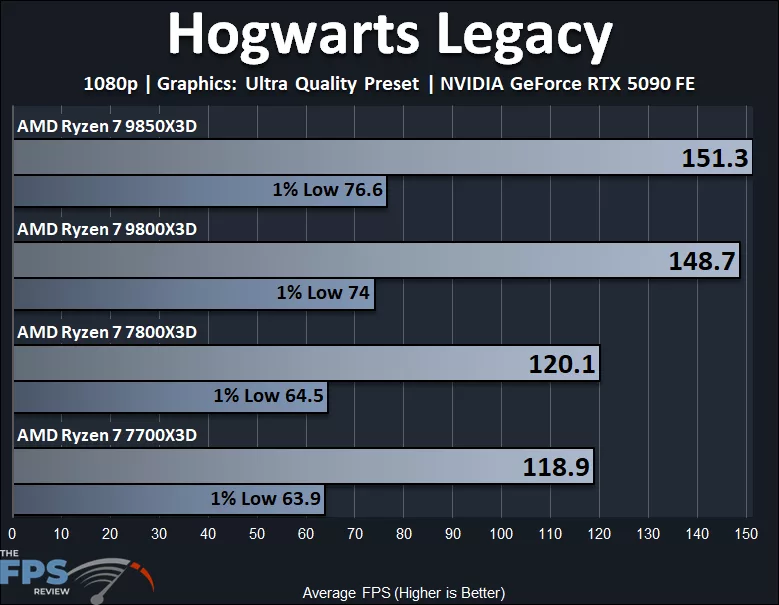
In Hogwarts Legacy, we saw massive framerate differences between Zen 4 X3D and Zen 5 X3D in this game. The Ryzen 7 9800X3D is 24% faster than the Ryzen 7 7800X3D in average framerate! In 1% Lows, it is 15% faster. The Ryzen 7 7800X3D is 1% faster than the Ryzen 7 7700X3D. The Ryzen 7 9850X3D is 2% faster than the Ryzen 7 9800X3D, and in 1% Lows it is 4% faster. Comparing fastest to slowest, the Ryzen 7 9850X3D is 27% faster than the Ryzen 7 7700X3D in average framerate and 20% faster in 1% Lows.
Horizon Forbidden West
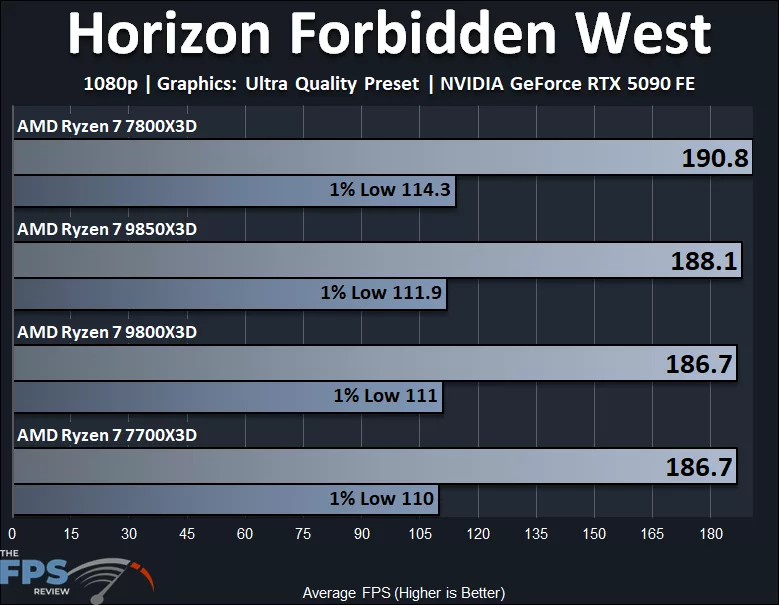
In Horizon Forbidden West, the performance differences are much more tame, but this is an aging game now. The Ryzen 7 7800X3D actually came out on top, but we are talking a few FPS differences here, so margin of error territory for our manual run-through. The difference between the fastest and slowest average framerate is only 2%, and the difference in 1% Lows is 4% in this game. Perhaps a different in-game area would show a different result; this was in an open outdoor run-through between villages.
Kingdom Come: Deliverance II
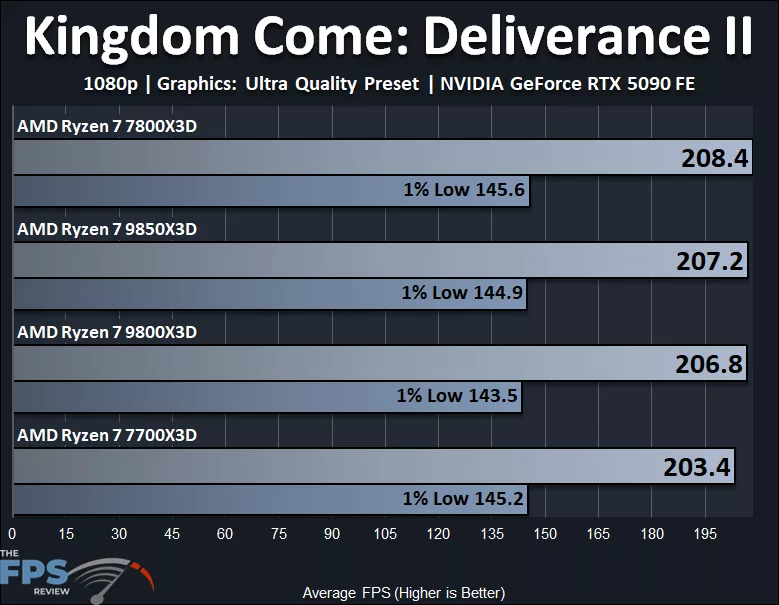
In Kingdom Come: Deliverance II, there was a measurable difference between the CPUs, but in this game it was very small between the CPUs in both average and 1% Lows. With the results so close, the Ryzen 7 7800X3D squeaked out on top, but again we are talking a few FPS differences. The difference in average framerate from fastest to slowest is only 2%, and the 1% lows are only 1%.
Resident Evil Requiem
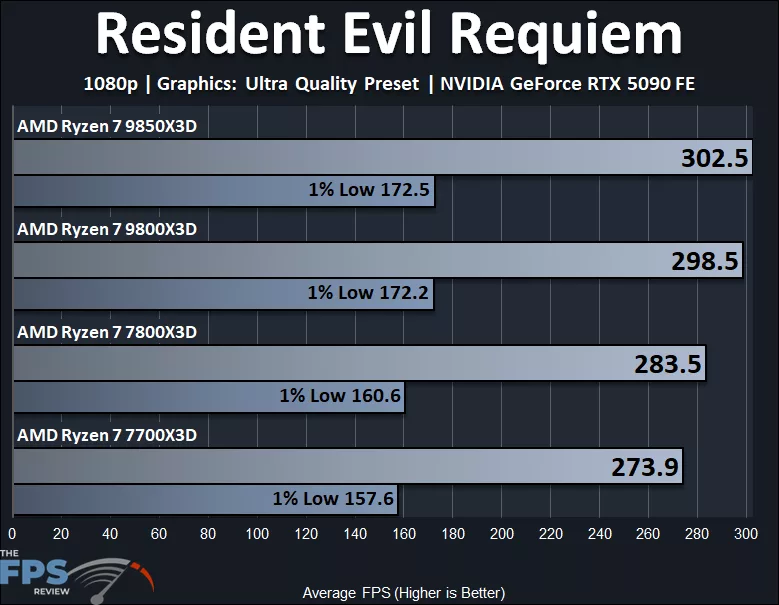
Resident Evil Requiem does show a difference in the CPUs here, with the Zen 5 X3D CPUs coming out on top over the Zen 4 X3D CPUs. The Ryzen 7 9800X3D is 5% faster than the Ryzen 7 7800X3D in average framerate and 7% faster in 1% Lows. The Ryzen 7 7800X3D was 4% faster than the Ryzen 7 7700X3D in average framerate and 2% faster in 1% Lows. The Ryzen 7 9850X3D was 1% faster than the Ryzen 7 9800X3D in average framerate and matched it in 1% Lows. Comparing fastest to slowest, the Ryzen 7 9850X3D was 10% faster than the Ryzen 7 7700X3D in average framerate and 9% faster in 1% Lows.
S.T.A.L.K.E.R. 2: Heart of Chornobyl
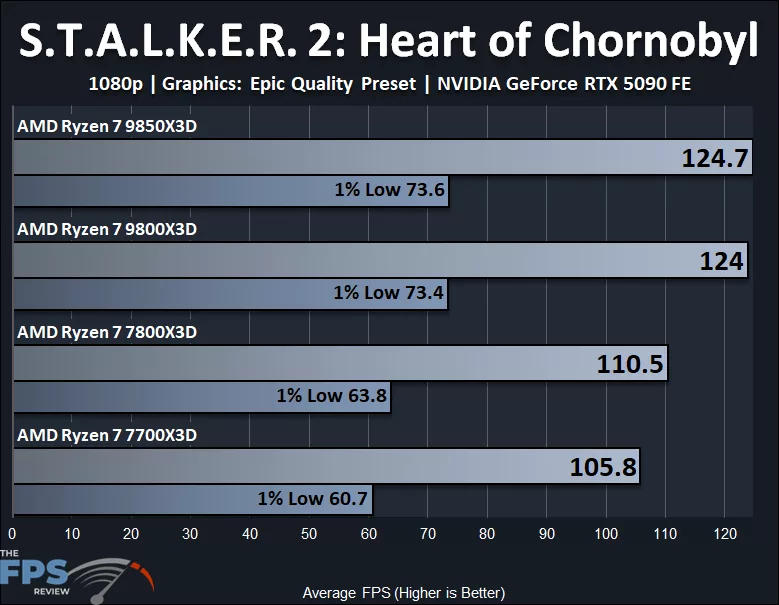
Stalker 2 was also a game not yet released when we tested the Ryzen 7 9700X. Note that we are using the newest patch of Stalker 2, which upgrades the Unreal Engine version to 5.5.4. In Stalker 2, we experience a pretty substantial difference with the Zen 5 X3D CPUs over Zen 4 X3D. The Ryzen 7 9800X3D is 12% faster in average framerate and 15% faster in 1% Lows. The Ryzen 7 7800X3D is 4% faster than the Ryzen 7 7700X3D in average framerate and 5% faster in 1% Lows. The Ryzen 7 9850X3D is practically the same performance as the Ryzen 7 9800X3D. Comparing fastest to slowest, the Ryzen 7 9850X3D is 18% faster than the Ryzen 7 7700X3D in average framerate and 21% in 1% Lows.
Discussion
Join Discussion →No replies yet. Be the first to reply on the forum.