
Load Testing
For those of you that are curious as to some of the reasoning and equipment behind our PSU testing program here at TheFPSReview, we have put together an introduction for you. This program is based on what the author developed at [H]ardOCP and utilizes the equipment bequeathed to the author by Kyle Bennett. The testing we are conducting today is exactly as described in that document and starts with our 120v, 100v, Torture, and 80 Plus Tests.
120v and 100v Load Testing Results
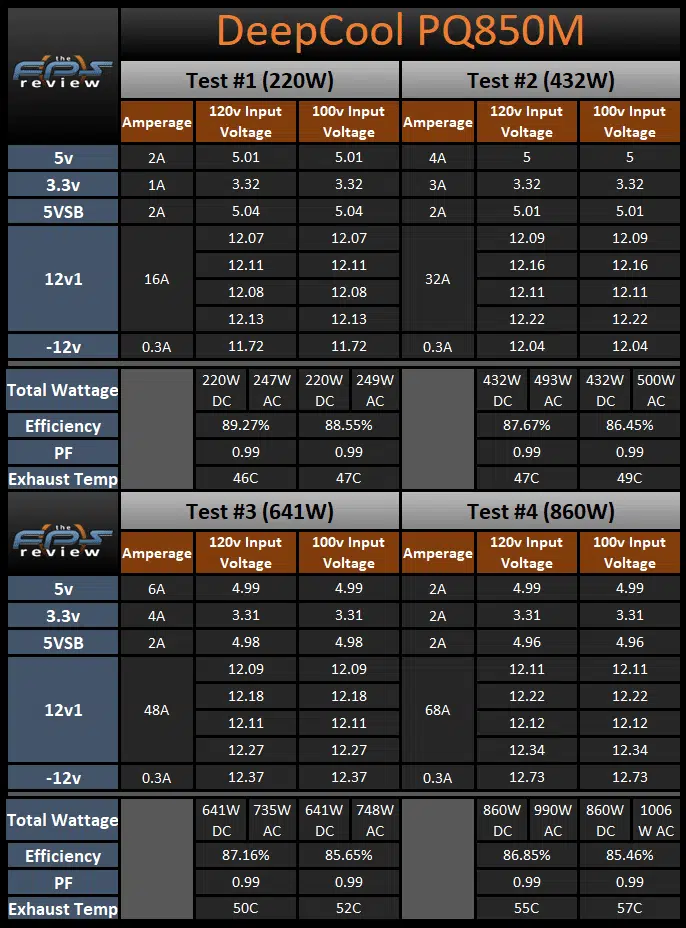
Test #1 is equal to approximately 25% of the rated capacity of the DeepCool PQ850M at 45c. This makes Test #1 equal to 220W by loading the 12v rail to 16a, the 5v rail to 2a, the 3.3v rail to 1a, the +5vsb to 2a, and the -12v to 0.3a. The results of Test #1 show the main positive DC output rails starting off above nominal. The efficiency for this unit is starting off in excellent shape at a value of 89.27% at 120v AC input and 87.67% at 100v AC input. We see the exhaust temperature is 46C at 120v AC input and 47C at 100V AC input.
Test #2 is equal to approximately 50% of the rated capacity of the DeepCool PQ850M at 45c. This makes Test #2 equal to 432W by loading the 12v rail to 32a, the 5v rail to 4a, the 3.3v rail to 3a, the +5vsb to 2a, and the -12v to 0.3a. Test #2 sees mixed results across the board in DC output voltages relative to what we saw with Test #1. These changes are up to 0.09v increase on the 12v rail while the 3.3v doesn’t budge and the 5v rail drops by 0.01v. The efficiency has dropped to 87.67% at 120v AC input and down to 86.45% at 100v AC input. We see an exhaust temperature of 47C at 120v AC input and 49C at 100V AC input.
Test #3 is equal to approximately 75% of the rated capacity of DeepCool PQ850M at 45c. This makes Test #3 equal to 641W by loading the 12v rail to 48a, the 5v rail to 6a, the 3.3v rail to 4a, the +5vsb to 2a, and the -12v to 0.3a. Test #3 sees mixed changes again. The 5v and 3.3v rails have dropped by 0.01v. The 12v rail moves up by up to 0.05v over Test #2 values. The efficiency in Test #3 moves down to 87.16% at 120v AC input and 85.65% at 100v AC input. We see an exhaust temperature of 50C at 120v AC input and 52C at 100V AC input.
Test #4 is equal to approximately 100% of the rated capacity of the DeepCool PQ850M at 45c. This makes Test #4 equal to 860W by loading the 12v rail to 68a, the 5v rail to 2a, the 3.3v rail to 2a, the +5vsb to 2a, and the -12v to 0.3a. In the final regular test, we see the 12v rail rise by up to 0.07v. The minor rails, however, show no change over Test #3 values. The efficiency has dropped, once more, as we see it come in at 86.85% at 120v AC input and 85.46% at 100v AC input. We see an exhaust temperature of 55C at 120v AC input and 57C at 100V AC input.
Torture Test
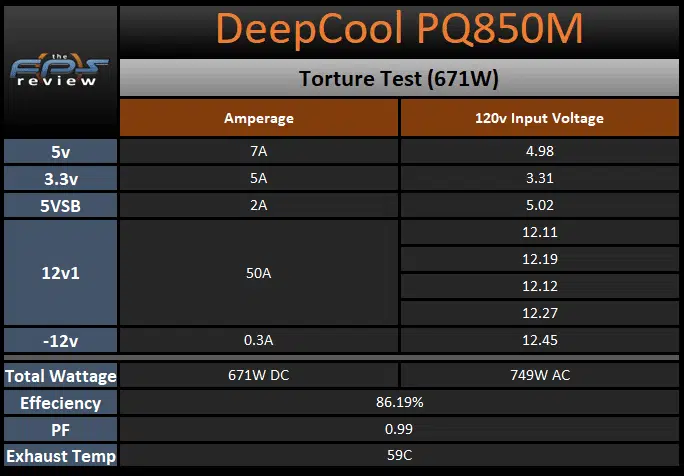
The Torture Test is equal to approximately 80% of the rated capacity of the DeepCool PQ850M at 45C. This makes the Torture Test equal to 671W by loading the 12v rail to 50a, the 5v rail to 7a, the 3.3v rail to 5a, the +5vsb to 2a, and the -12v to 0.3a. At the end of the Torture Test, the PQ850M is still doing fine. The DC output voltages are generally in line with what we have been seeing in the 120v load tests. The efficiency is decent as we see a value of 86.19% and the exhaust temperature is 59C.
80 Plus Load Testing Results
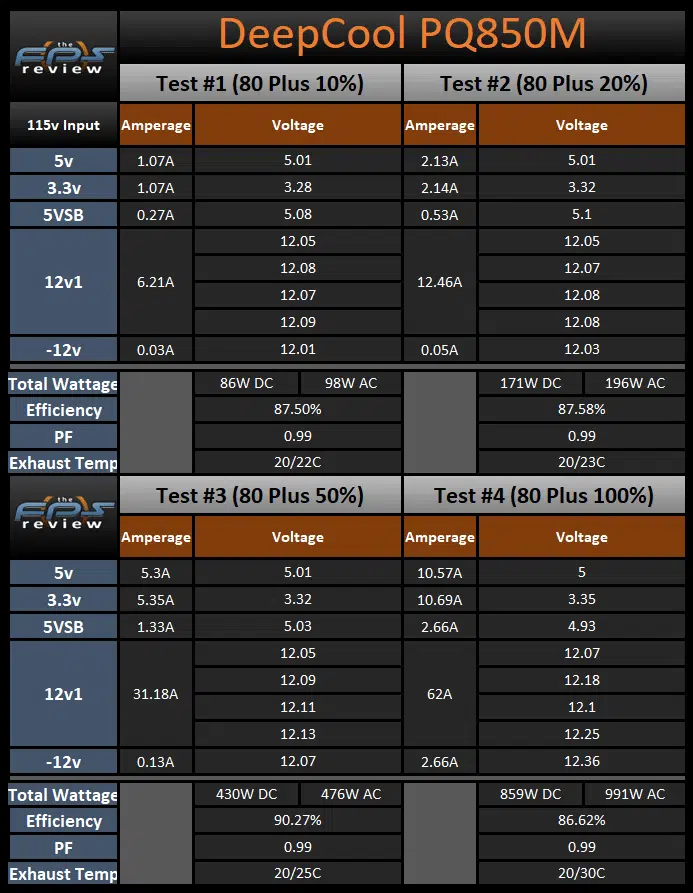
As we see here, the DeepCool PQ850M posts efficiency values of 87.58%-90.27%-86.62% efficient using 80 Plus’ load testing parameters. This puts the unit under the 80 Plus Gold standards at 100% load by 0.38%. However, we do use different equipment than 80 Plus for our testing and there is always a bit of component variation.
Load Testing Summary
Today, the DeepCool PQ850M proved to be a good power supply in our initial load testing. When we look at the voltage regulation, we see that the PQ850M had peak changes of 0.21v on the 12v rail, 0.02v on the 5v rail, and 0.01v on the 3.3v rail. Interestingly, we have a few directly comparable products to look at today. As it were, the PQ850 was mixed compared to all of those products! This includes the SilverStone DA850 Gold, Enermax REVOLUTION DF 850W, MSI MPG A850GF, and ASUS ROG THOR 850W we reviewed some time ago. The reason for this result is the rather loose 12v regulation but the very tight regulation of the minor rails. So, these absolute values are in the specification and this unit, at first glance, compares very favorably with other, similar, products. However, one must look a little closer to get a real feel for how this unit fares.
When we look at the efficiency side of things, we see that the PQ850M ranged from 86.85% to 89.27% efficient at 120v AC input and 85.46% to 88.55% efficient at 100v AC input which is very good. This unit, however, did miss out on its 80 Plus rating as it posted values of 87.58%-90.27%-86.62% which means it faltered at full load. Lastly, the exhaust temperature peaked at 55C at 120v AC input, 57C at 100v AC input, and 59C during the Torture Test. With excellent starting results in today’s testing, let’s move on to the Transient Load Tests.
Discussion (6 replies)
Join Discussion →Thanks for the review! Interesting to see them put out a PSU. I know they've been in the cooler business for a while now but didn't know they did PSUs as well.
That, my friends, is where this unit runs headlong into a house while speedballed out of their mind like Anne Heche in an Austin Mini.
Damn that’s cold. Hilarious, but the dirt hasn’t even settled on the grave yet.
Some times the inspiration just slams right into you.
I find this interesting and if I were in the market for a 850 watt power supply I would want platinum or titanium rated personally. Getting every ounce of efficiency will be critical with new modern parts at least in my mind.
Hmm, I don't know that the effiency matters much.
The wattage is based on DC side - so an 850 Titanium will deliver the same 850W that a 850 Bronze will -- they will be identical as far as the computer load you can throw on them goes.
Granted, the bronze would pull a bit more from the wall... but it's only a difference of 8% (82% vs 90%) - or 80W... at 85%.
And if you have no qualms about a 500W+ Graphics card or 250W+ CPU (Not saying you personally Grim, just the general "making a point") -- then that extra 8% is nothing. Maybe if you are rocking one of those 1500W+ PSUs, and then that extra 8% may be the difference between throwing a breaker or not - and that would be a legitimate reason for a gamer or home computer user to care.
Buy a power supply for the voltage quality, the warranty, the bells and whistles that you like -- but the Plus rating is mostly just a marketing badge. It might matter in a server situation where it's going to sit under load for long stretches of time (like 24x7), or maybe if you are mining full time, but it needs to be on at a healthy load for a long time if you ever want to recoup that price difference.
I'll grant you that higher tier PSUs tend to be better units, but it isn't because they are higher tier rated. The tier rating is a good reason for the manufacturer to put a higher markup on a product, but you shouldn't pay extra for just that. Pay extra for stuff that matters, like good voltage quality or cable management or 10 year warranty. It's a shame that stuff is hard to sleuth out if all you have is the box on the shelf to go by - which is why I love sites like this one.
I agree with everything you said. I consider warrranty and reputation as well. When I got my 1300 watt I wanted high efficiency. I didn't even realize titanium rated was a thing or I would have looked for it. (hard to find mind you.) And I know I over paid for my power supply but for me that piece out lives dang near every other component of my system. My old 850 watt that ran my 3900x is being given to a friend with the 3900x cpu and motherboard and the 1 tb nvme drive I had in it to boot. so it will see more life.