
Overclocking ASUS TUF Gaming GeForce RTX 4070 Ti OC
Default
Before we find the highest stable overclock, we need to find out what the default GPU clock speed of the video card is. With both NVIDIA and AMD GPUs, the GPU frequency is dynamic. NVIDIA has GPU Boost, and AMD has its Game Clock and Boost Clock quoted frequencies. Typically, GPUs today can exceed the “Boost Clock” dynamically. We need to find out what it actually runs at in-game, so we can compare the benefit of overclocking. To do this we will record the GPU clock frequency over time while playing a game. We use Cyberpunk 2077 for this with a very long manual run-through at “Ultra” settings recording GPU-Z sensor data.
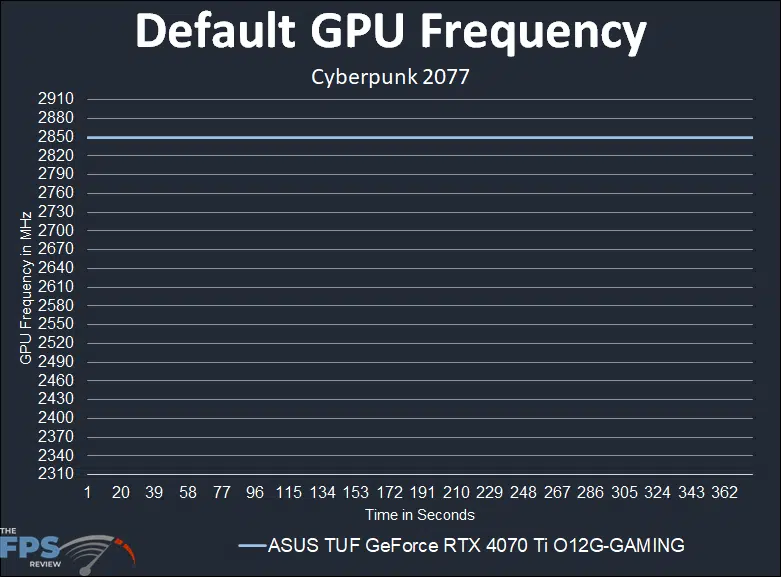
The ASUS TUF Gaming GeForce RTX 4070 Ti OC has a factory boost overclock set at 2730MHz, up from the reference spec of 2610MHz. The real-world gaming frequency of the video card while gaming held a steady and consistent 2850MHz for the entire gaming session, not dipping once. This is a very stable and predictable performance level. At 2850MHz the video card was boosting 120MHz (4.3%) above the factory overclock. If we compare this to the reference spec, then the video card is running 240MHz (9%) faster than the reference spec by default.
Overclocked
To overclock the ASUS TUF Gaming GeForce RTX 4070 Ti OC video card we are using the manufacturer-provided overclocking software which in this case is the latest version of ASUS GPU Tweak III. This is our highest stable overclock shown below.
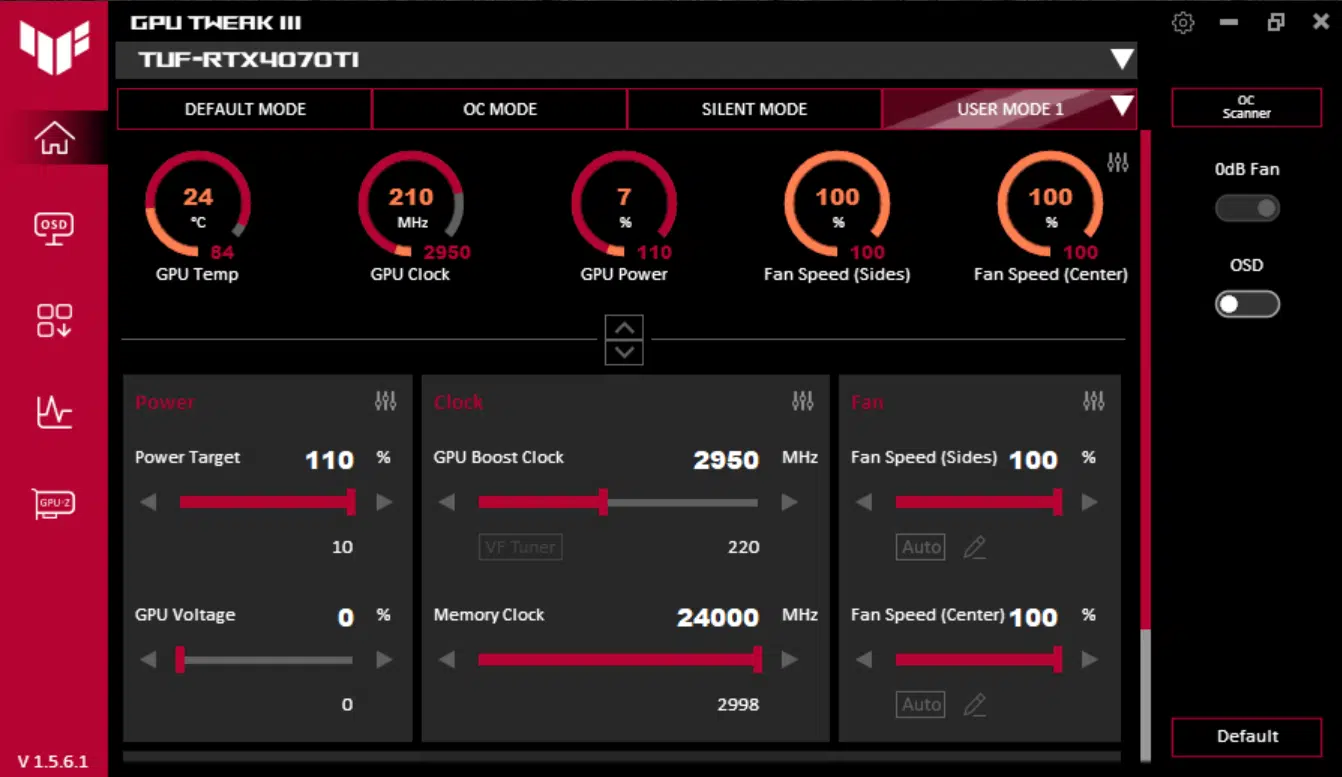
How do you overclock the ASUS TUF Gaming GeForce RTX 4070 Ti OC video card? You start by loading up GPU Tweak III and find that you are able to increase the Power Target up by 10% from 100% to 110% for a higher power headroom. We can also increase the fan speed and GPU Voltage as needed. In the screenshot above we managed to hit a GPU Boost Clock of 2950MHz for our highest stable overclock setting, and the memory was able to overclock up to 24GHz from the default 21GHz.
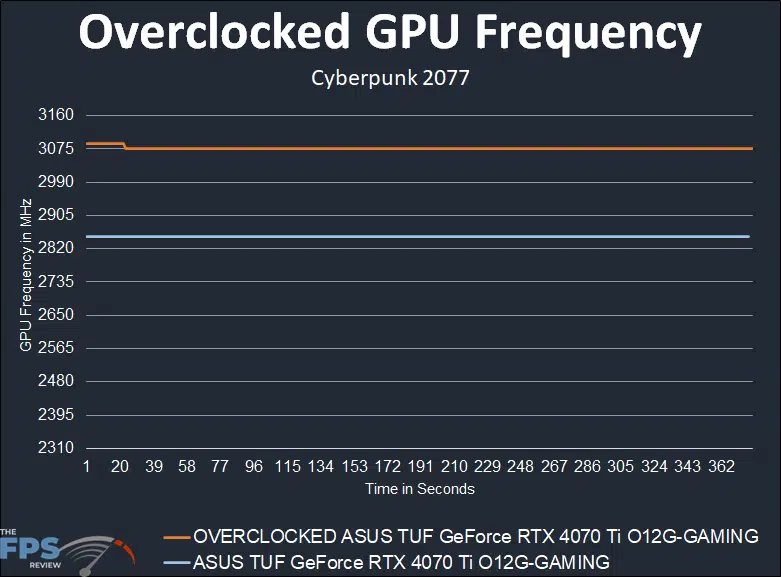
Overclocking the video card with the GPU Boost Clock at 2950MHz resulted in the overclock shown above, where it starts out at 3090MHz, but then settles at 3075MHz for the entire gaming session. Therefore, our real-world gaming clock while gaming is 3075MHz up from the default 2850MHz without the overclock. We broke the 3GHz barrier. At 3075MHz we are achieving a 225MHz or 8% overclock over the default operation. Comparing this overclock to the NVIDIA reference spec, this is a 465MHz or 18% higher clock speed, at the NVIDIA reference spec of 2610MHz.
Discussion (19 replies)
Join Discussion →Aaaand, it's a dud. The 7900 XT now actually makes sense.
Sort of want, but will wait until under 500. 1080ti still gets job done.
Ok, so this is only tangential to the topic... but at what point do you get to call it either a monopoly or price fixing?
Now, I do not think that AMD and nVidia are colluding to raise consumer prices. I think nVidia is doing it because they can get away with it, and AMD is just playing along with "just slightly less than" pricing because their shareholders would oust them outright if they didn't.
There is no government limit on the margin a company can ask, or the profit they can pull in. That's kinda how capitalism works. But I sure hate this feeling that we are just getting utterly taken advantage of. I guess it's just a hobby, I don't have to play along - I just hate seeing it happen before my eyes.
Nvidia has enormous pricing power because of RTX & DLSS3
At the premium price points ($500 plus) people most likely go by added features rather than outright raster performance
What is surprising is that: even in below $500 prev gen GPUs, higher price Ampere cards outsell equivalent but much cheaper RDNA 2 cards
If more people purchase Navi 22 cards (RX 6750 XT, 6700 XT, RX 6700) instead of Ampere, than Nvidia might get the message !!
DLSS3 itself isn't a real selling point. It exists, and it has a purpose - but not for most gaming scenarios. DLSS2 is still the main DLSS technology and remains more competitive overall, especially in situations where RT is used with heavy loads overall.
If nvidia pushes DLSS3 as hard as they pushed DLSS, we'll see support in most upcoming games.
Besides, 100% performance increase does sound like a big selling point.
Thanks, @Brent_Justice for the very thorough review which answered nearly every question I could have about this card.
Well, it seems the card lies between the RTX3090 and 3090Ti, but men the thing gets bandwidh starved at 4k
I'm really impressed just becauese looking at the specs I really didn't think it would do that good.
Great review!
I figured Nvidias "faster than 3090ti" claims were going to be all fluff, but it does at least get close most of the time, and actually succeeds in others.
Still, not quite sure I'd be happy with the value proposition $799 is a lot for a mid range card.
If I could make a request, if it isn't too much of a main in the ass, Minimum/1%/0.1% framerates are very relevant and would add a lot of information to your reviews. I'd even argue that minimum frames are MORE relevant that average frames.
Sure?
DLSS 1.0 was pretty bad - but showed the promise of intelligent upscaling.
DLSS 2.0 has more or less delivered on that promise. My opinion, of course; I find DLSS 2.0 to be more than close enough to justify any perceived degradation in visuals. Granted I have no problem using FSR / FSR 2.0 where exclusively available, whether I'm gaming on an AMD GPU or that's just what the game in question supports.
DLSS 3.0 is 'frame doubling'. This works great for pre-recorded media (if you like the effect itself), but for real-time applications it means that there's a definite insertion of additional input latency attached with usage. So, for DLSS 3.0 to even be useful in a particular situation, performance already has to be high enough for real-time interaction. Whereas DLSS 2.0 taking you from an arbitrary 20FPS to 35FPS, or 60FPS to 90FPS and so on can significantly impact the quality of the experience, DLSS 3.0 (that is, the 'frame generation' part of it) needs you to be running at 60FPS+ in the first place.
And there's a place for that - many games that aren't as user-response dependent can benefit, thinking anything turn-based or perhaps RPG and adventure-style games. Some simulators as well.
But for anything where optimizing for input latency is already a concern, DLSS 3.0 is a non-starter.
No one should be! But it's still the cheapest entry point for the level of technology Nvidia is bringing to the table.
BTW seems to me the cards are unnecessarily big. It seems the PCB is about 2/3 the size of the card.
I wonder if they reused parts from its bigger brothers to save R&D and inventory costs.
It's a tradeoff. It costs more per unit, but it saves having to develop new parts.
Yeah, I'm sure. There are already about 50+ games announced that will support DLSS3. If someone know how to shove new technology down your throat, that's nvidia. BTW thanks to nvidia reflex, latency is actually lower than without DLLS3. Not saying its going to be great, but by now DLSS already gained high praise and is considered a must have for many gamers, DLSS3 at least deserves a chance.
Anyway AMD is also having its own frame interpolation/frame creation technology coming soon. We'll see.
I haven't owned a Nvidia GPU newer than my 2016 Pascal Titan X, so I ahve not personally played with DLSS yet.
Can all titles that support DLSS3 also run DLSS2? In other words is it backwards compatible or an option?
Because I too tend to think - from what I have read and seen, through not through personal experience) that DLSS2 was the pinnacle of the tech.
Pretty sure the answer is yes. Brent has a write-up on it in his 4090 review that also goes a little more in-depth about the frame generation feature. It's about midway down the first page.
https://www.thefpsreview.com/2022/10/11/nvidia-geforce-rtx-4090-founders-edition-review/