
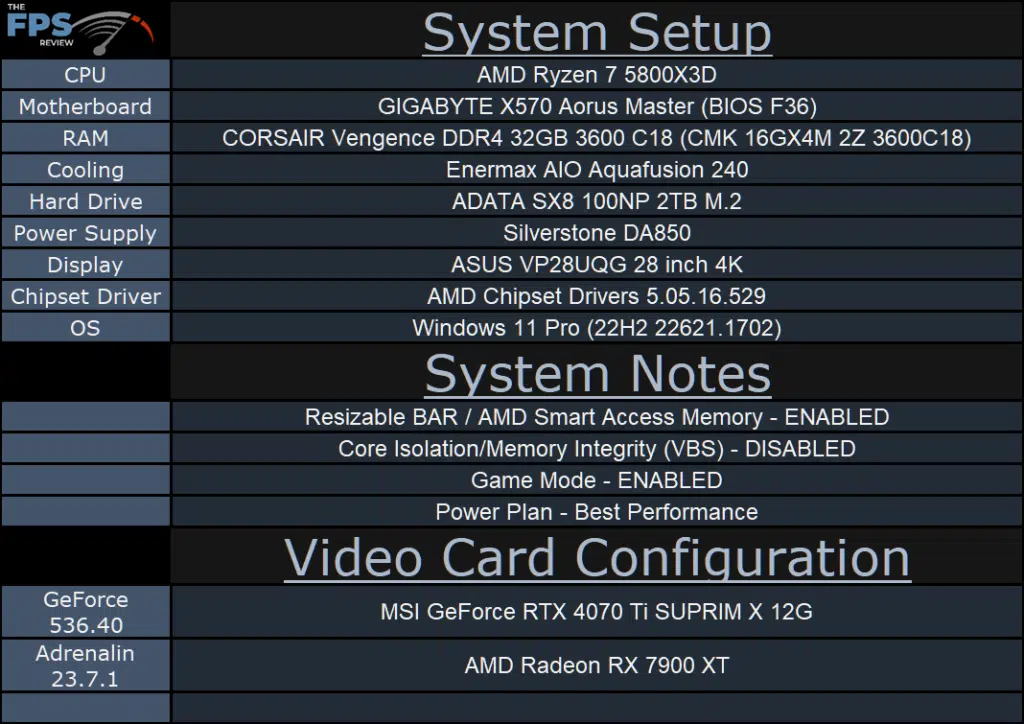
Test System Setup
More information on our GPU testing can be found here. We are using the motherboard’s current default BIOS settings on the latest official release BIOS. We have enabled PCI-Express Resizable BAR in the motherboard BIOS. This means we are utilizing Resizable BAR on NVIDIA GPUs and AMD Smart Access Memory on AMD GPUs in all of our testing. We have enabled DOCP in the BIOS for the memory. We are using a fresh install of Windows 11 Pro with the latest Windows Updates, and drivers installed including the latest chipset drivers from AMD. We are using the “Best Performance” power profile in Windows Settings. We have Hardware Accelerated GPU Scheduling at the default setting, which is ENABLED. VBS is DISABLED and Game Mode is ENABLED.
Discussion (6 replies)
Join Discussion →nice writeup. Still too rich for my blood. I refuse to spend over $500 on a GPU
I think the RTX4070Ti is a pretty good card but about $100 too much. D*mn I remember the days I would get awesome cards for $300.
I remember my 1070 back in the day was around 450 if I remember correctly.
Back then, I got a great deal on my GTX1070 for $350 and then a GTX1070Ti for $375. Just before the mining craze
In the introduction you provide an overview of the three tiers: "The SUPRIM is at the top, Gaming Trio next, and Ventus at the bottom. The SUPRIM and Gaming Trio have an X and non-X version, X denoting overclock. The Ventus is simply OC or not. In the RTX 4070 Ti, MSI also offers a white version of the Gaming Trio X and non-X."
Maybe I'm an exception, but I would actually rather buy a video card that isn't factory overclocked.
I'm curious whether anyone knows what sort of binning goes on and how that might affect chip quality not only among the tiers but also the "X" or "OC" variants. A card that draws less power and is cooler at stock speeds is desirable too, but if that is a goal then buying a factory-overclocked card seems a little bit counterintuitive. I wonder whether (for example) the non-X variant of the SUPRIM card would be of equal quality to its X counterpart, but without the factory overclock.
Just a curiosity of mine...
I don't anticipate buying any of the 4000-series cards.
Those are very good prices. The MSRP of the GTX 1070 was $379 at launch. I bought an MSI GeForce GTX 1070 GAMING X for $400 toward the end 2016. (It included a $20 mail-in rebate that I managed to screw up by waiting too long. My perfect rebate record was ruined. ?)
$330 I think for an open box Asus 1070 from microcenter. Those were the days.