
Overclocking the MSI GeForce RTX 4070 Ti Supreme X
Prior to overclocking, we determine the baseline GPU clock speed. Both NVIDIA and AMD have dynamic baseline speeds. The GPU clock frequency in games is referred to as the Game Clock on AMD video cards and Boost Clock on NVIDIA cards. Generally, either brand’s card will exceed this baseline frequency dynamically. To determine the “baseline” we record the GPU frequency in our Cyberpunk 2077 manual run-through. This is a lengthy manual run at Ultra settings. Data is captured for frequency, temperature, voltage, and power using the GPU-Z sensor to log the data.
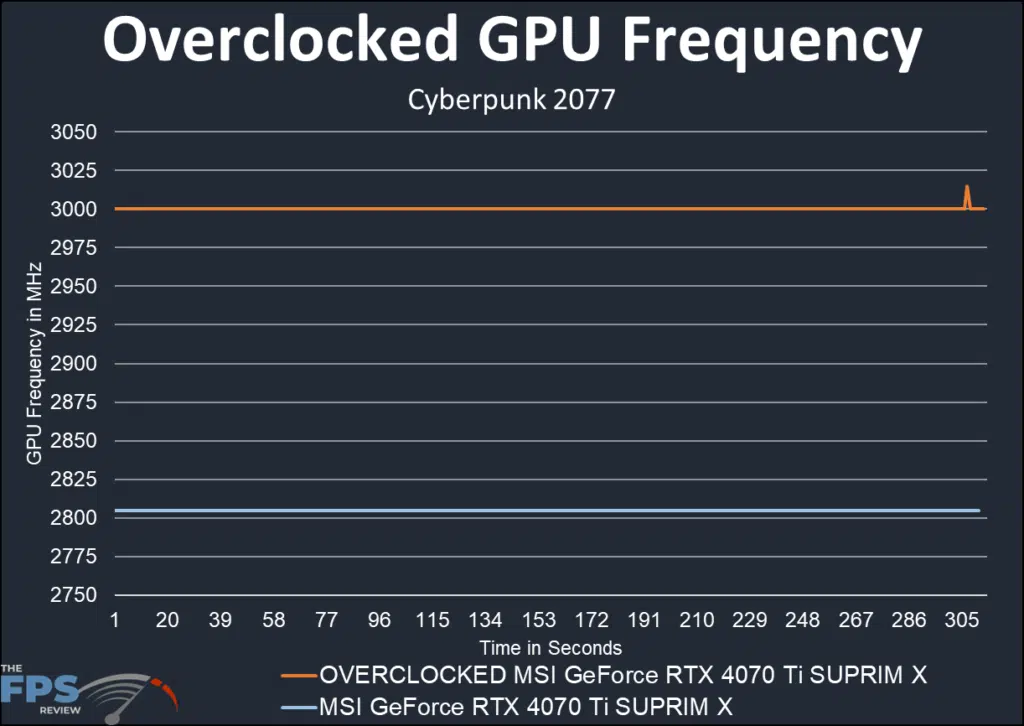
The MSI GeForce RTX 4070 Ti SUPRIM X overclocked very well. The striking piece about these two frequencies is the absolute straight line. Once the benchmark run-through is started the clocks maintain the same frequency throughout over 5 minutes of manual gaming. The default out-of-the-box Boost clock is 2805MHz, while the listed reference Boost clock frequency is 2610MHz. This equates to a 7.5% increase right from the jump. That said, the MSI factory overclock is 2775MHz, so in reality we are seeing a 30MHz jump in the default settings which is about 1%.
When we apply our overclock to the MSI RTX 4070 Ti SUPRIM X, we were able to reach a steady 3005MHz, this additional boost is 200MHz which is 7.5% up from the default Boost Clock and 15% up from the reference Boost Clock. That is not bad right there.
To overclock our video card we utilized the tried and true MSI Afterburner. In use was version 4.6.5. Afterburner allowed us to adjust everything, clock frequencies, memory frequencies, GPU voltage, and of course power limit and temperature limit. In the first few trials, we noticed that the GPU Hot Spot was near 84C with the fans set to automatic. It seemed appropriate to increase the fan speed, which was then set to 60%. This was the sweet spot. The video card ran cool and the fans were nearly silent.
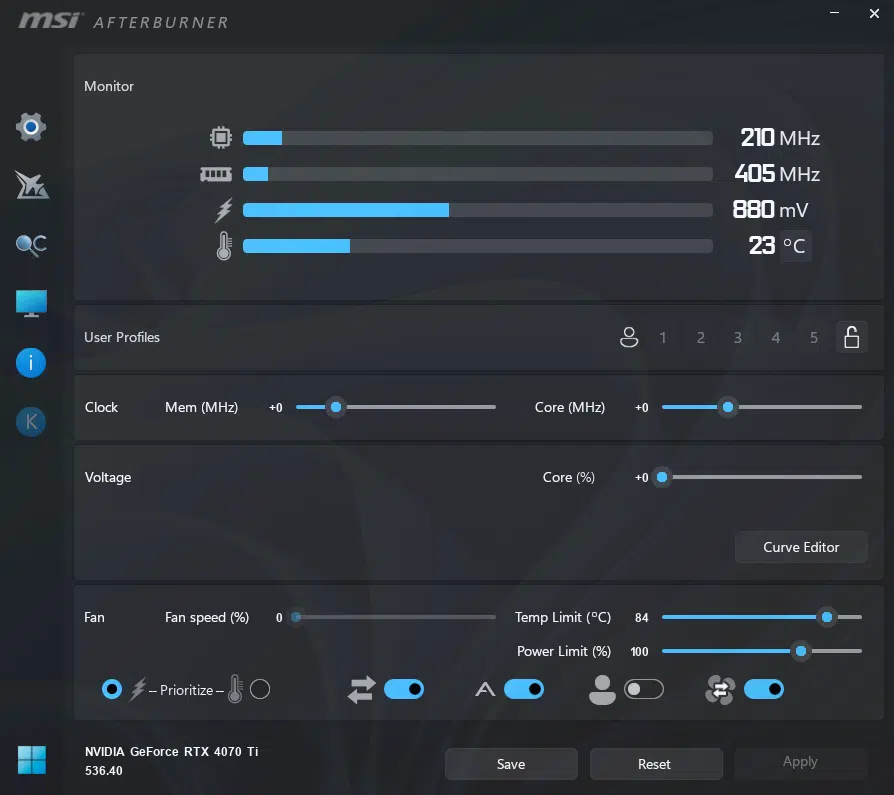
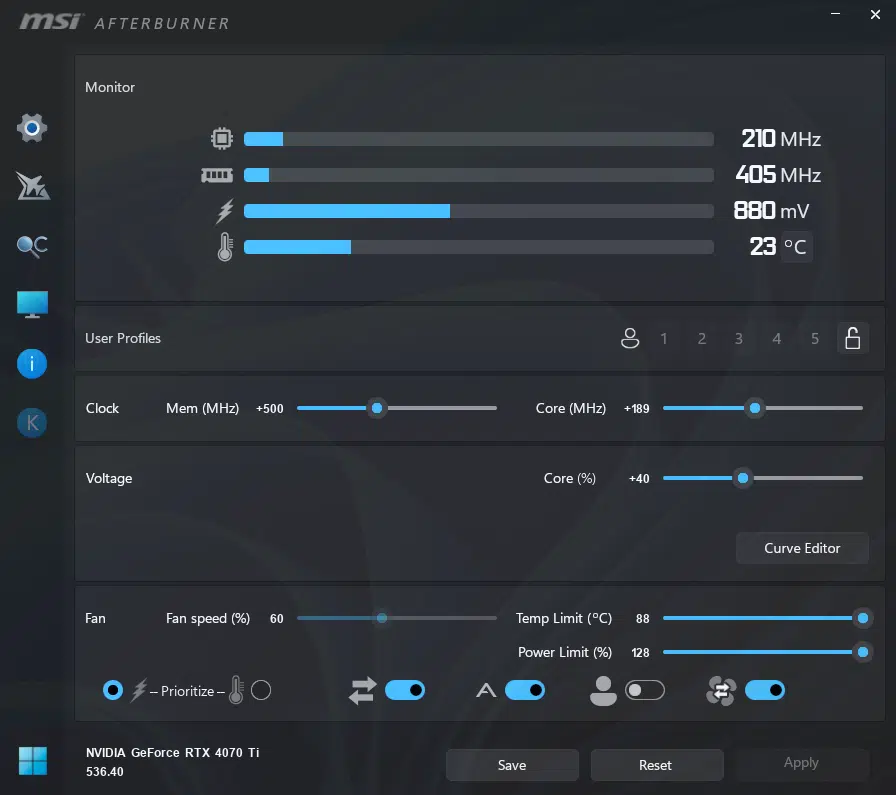
The final settings are listed in the right-hand screen capture below. GPU MHz was +189, memory +500, voltage +40% (equating to a .01 volt increase) power offset to 128%!!! and temperature offset to 88C. I was able to go even higher in Callisto Protocol. The card ran +205MHz equating to a Boost Clock of 3075MHz. This was also stable in Cyberpunk 2077 and Dying Light 2. Unfortunately, the card was unstable in Forspoken, Returnal, and Chernobylite.
All in all the MSI RTX 4070 Ti SUPRIM overclocked well, stayed comfortably cool, and was very quiet. If we had really pushed the voltage, there was probably more performance to be had. This card is certainly designed for it.
Discussion (6 replies)
Join Discussion →nice writeup. Still too rich for my blood. I refuse to spend over $500 on a GPU
I think the RTX4070Ti is a pretty good card but about $100 too much. D*mn I remember the days I would get awesome cards for $300.
I remember my 1070 back in the day was around 450 if I remember correctly.
Back then, I got a great deal on my GTX1070 for $350 and then a GTX1070Ti for $375. Just before the mining craze
In the introduction you provide an overview of the three tiers: "The SUPRIM is at the top, Gaming Trio next, and Ventus at the bottom. The SUPRIM and Gaming Trio have an X and non-X version, X denoting overclock. The Ventus is simply OC or not. In the RTX 4070 Ti, MSI also offers a white version of the Gaming Trio X and non-X."
Maybe I'm an exception, but I would actually rather buy a video card that isn't factory overclocked.
I'm curious whether anyone knows what sort of binning goes on and how that might affect chip quality not only among the tiers but also the "X" or "OC" variants. A card that draws less power and is cooler at stock speeds is desirable too, but if that is a goal then buying a factory-overclocked card seems a little bit counterintuitive. I wonder whether (for example) the non-X variant of the SUPRIM card would be of equal quality to its X counterpart, but without the factory overclock.
Just a curiosity of mine...
I don't anticipate buying any of the 4000-series cards.
Those are very good prices. The MSRP of the GTX 1070 was $379 at launch. I bought an MSI GeForce GTX 1070 GAMING X for $400 toward the end 2016. (It included a $20 mail-in rebate that I managed to screw up by waiting too long. My perfect rebate record was ruined. ?)
$330 I think for an open box Asus 1070 from microcenter. Those were the days.