
Gaming Performance at 4K with Ray Tracing
This section uses 4K resolution and enables Ray Tracing in the game, with all the same settings as at 1440p.
Returnal
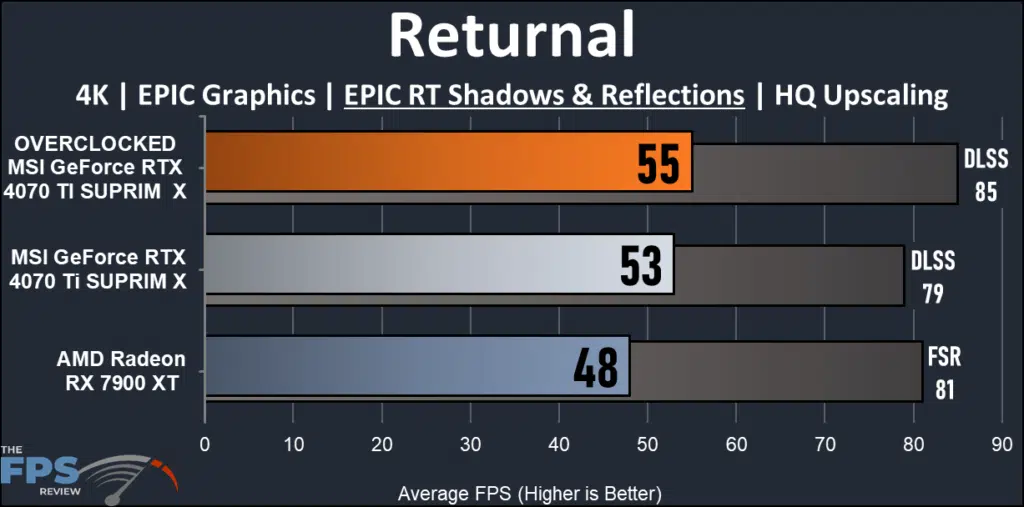
Without upscaling the game is unplayable. The MSI RTX 4070 Ti SUPRIM X is 10% better without and 2% slower when upscaling is enabled. The overclocked card is the overall winner by 2%. Upscaling works its magic in this game with Ray Tracing enabled.
Forspoken
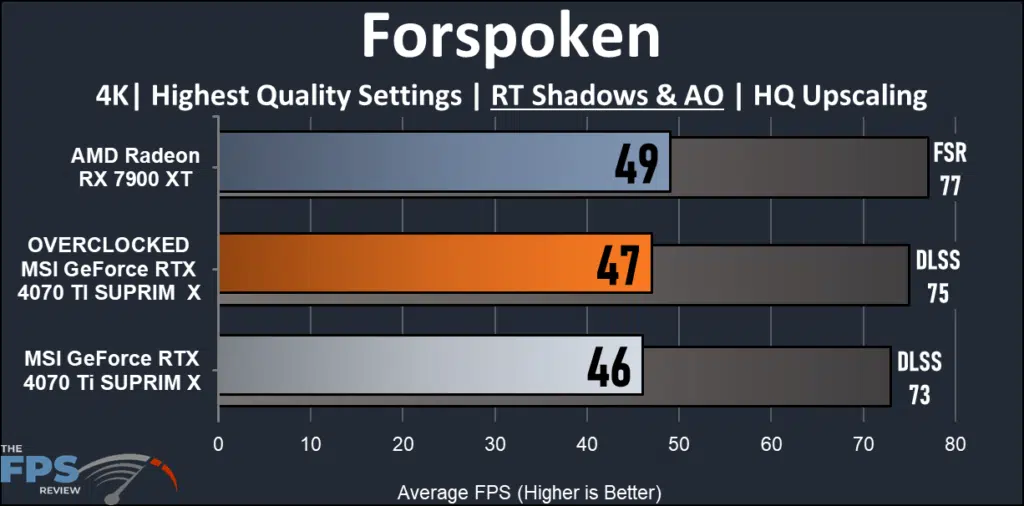
The results here are the reverse of Returnal. The RX 7900 XT comes out on top by a slim margin. ( 2%) Neither card is playable without upscaling. Overclocking is little help here.
Callisto Protocol
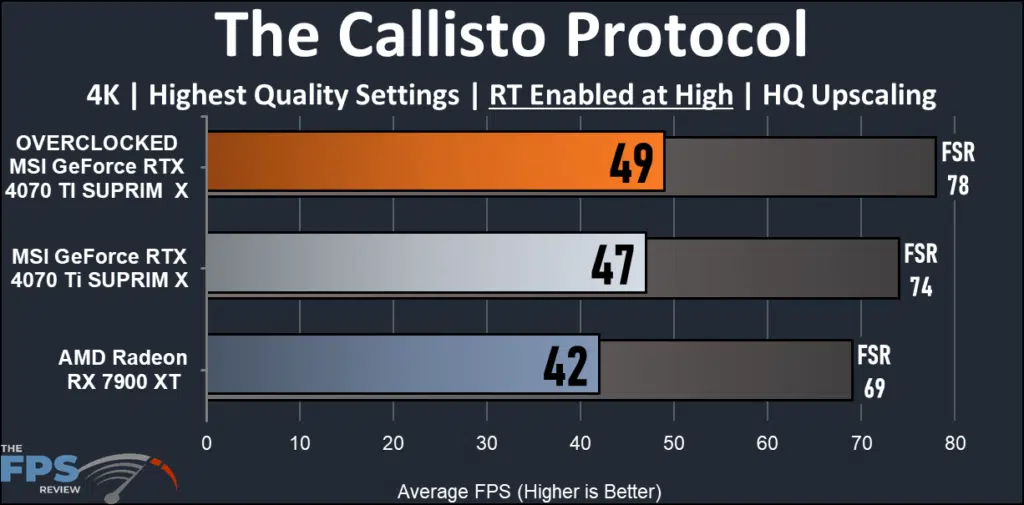
Well, let’s just turn around and go the other way! OK. Flip-flop again. This time we see the MSI RTX 4070 Ti SUPRIM X faster by a 10% margin and 7% when upscaled. Both cards are not playable until upscaled. The overclocked card is once again the best result by a slim 2%.
Chernobylite Enhanced Edition
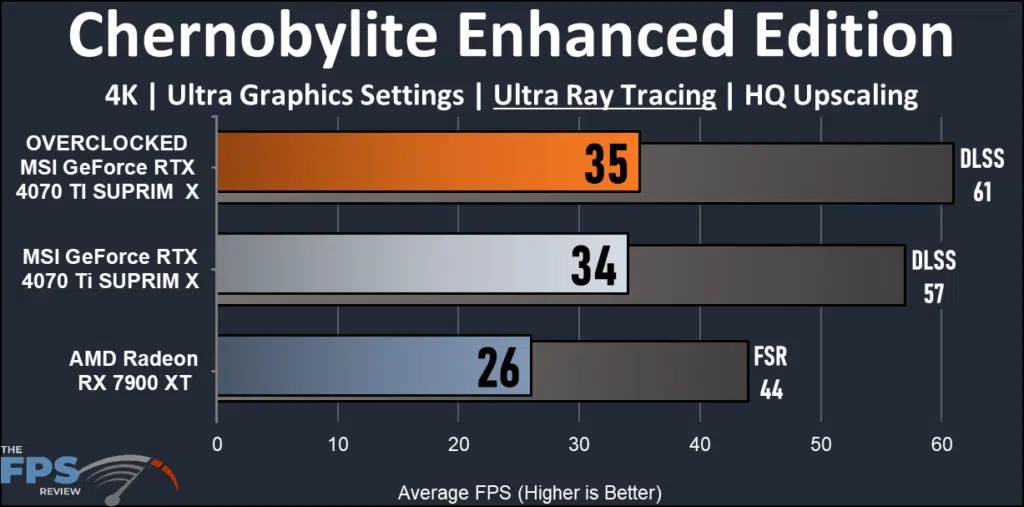
This game is very demanding with Ray Tracing enabled. Both cards are struggling and choppy in this game with and without upscaling. The MSI RTX 4070 Ti SUPRIM X is 30% better but that doesn’t mean a whole lot here. Only the overclocked card is playable and only with upscaling and then barely.
Dying Light 2
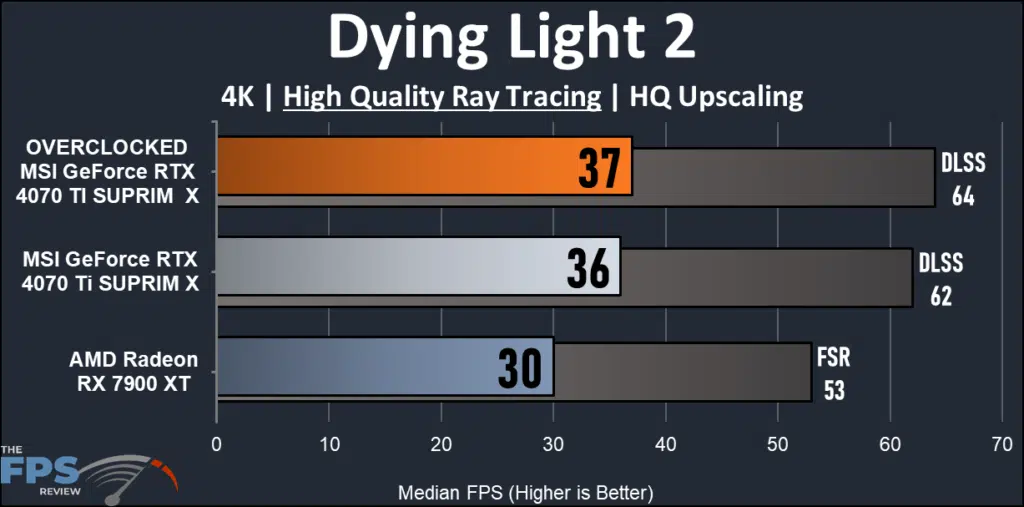
Similar results as in Chernobylite. The MSI RTX 4070 Ti SUPRIM X is faster by 20 and 17%, but only playable upscaled. Again we see the overclocked card is slightly faster.
Cyberpunk 2077
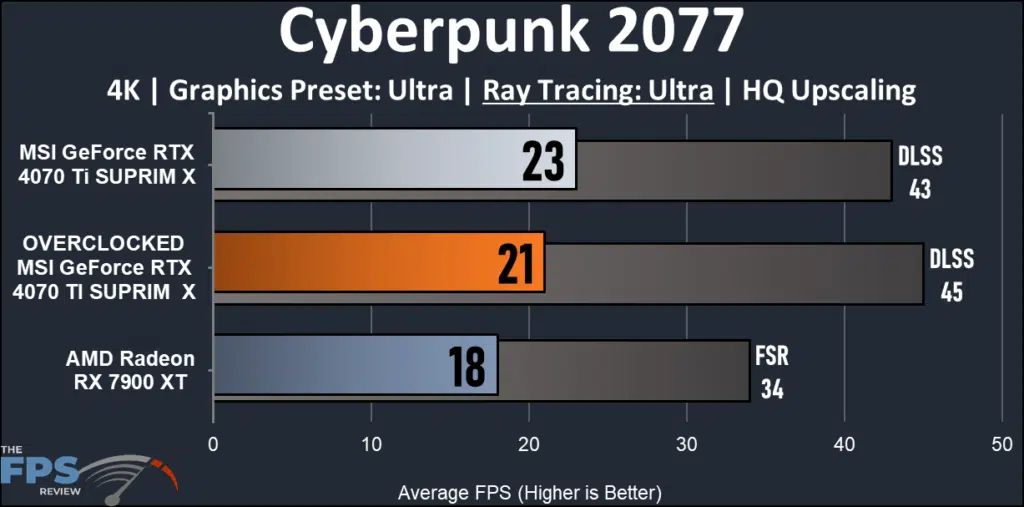
To close up our benchmarks, a full-court failure. Neither card has the horsepower to run this game at these settings. The MSI RTX 4070 Ti SUPRIM X is best by 27% and 33% but again, it doesn’t mean much when the best you can muster is 43FPS.
That being said, there is some magic to be had…..we enabled DLSS “performance” mode and also enabled NVIDIA Frame Generation, and ran the same benchmark. The result: 95FPS. That’s pretty good right there!
Discussion (6 replies)
Join Discussion →nice writeup. Still too rich for my blood. I refuse to spend over $500 on a GPU
I think the RTX4070Ti is a pretty good card but about $100 too much. D*mn I remember the days I would get awesome cards for $300.
I remember my 1070 back in the day was around 450 if I remember correctly.
Back then, I got a great deal on my GTX1070 for $350 and then a GTX1070Ti for $375. Just before the mining craze
In the introduction you provide an overview of the three tiers: "The SUPRIM is at the top, Gaming Trio next, and Ventus at the bottom. The SUPRIM and Gaming Trio have an X and non-X version, X denoting overclock. The Ventus is simply OC or not. In the RTX 4070 Ti, MSI also offers a white version of the Gaming Trio X and non-X."
Maybe I'm an exception, but I would actually rather buy a video card that isn't factory overclocked.
I'm curious whether anyone knows what sort of binning goes on and how that might affect chip quality not only among the tiers but also the "X" or "OC" variants. A card that draws less power and is cooler at stock speeds is desirable too, but if that is a goal then buying a factory-overclocked card seems a little bit counterintuitive. I wonder whether (for example) the non-X variant of the SUPRIM card would be of equal quality to its X counterpart, but without the factory overclock.
Just a curiosity of mine...
I don't anticipate buying any of the 4000-series cards.
Those are very good prices. The MSRP of the GTX 1070 was $379 at launch. I bought an MSI GeForce GTX 1070 GAMING X for $400 toward the end 2016. (It included a $20 mail-in rebate that I managed to screw up by waiting too long. My perfect rebate record was ruined. ?)
$330 I think for an open box Asus 1070 from microcenter. Those were the days.