
Synthetic System Benchmarks
We are going to start with synthetic system application benchmarks on this page. Note that the graphs are arranged from fastest to slowest. We have also highlighted the Intel Core i9-14900K at both memory speeds, for easy visualization.
PCMark 10
PCMark 10 Express
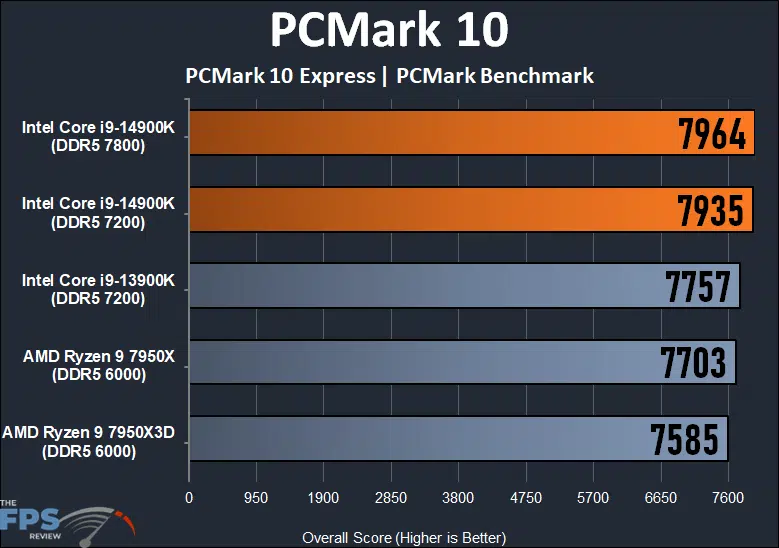
This benchmark focuses mainly on more lightly threaded office application types of workloads. Right off the bat, we do see a slight difference in performance between 7800MT/s DDR5 and 7200MT/s DDR5, but it isn’t a great amount, barely a thing here. Compared to the Intel Core i9-13900K, the Intel Core i9-14900K at its fastest is 3% faster as an uplift from the previous generation, so quite small overall. Compared to the Ryzen 9 7950X it is also only 3% faster. The Ryzen 9 7950X3D falls behind due to the clock speed here, the non-X3D version is better suited for office work tasks.
Geekbench 6
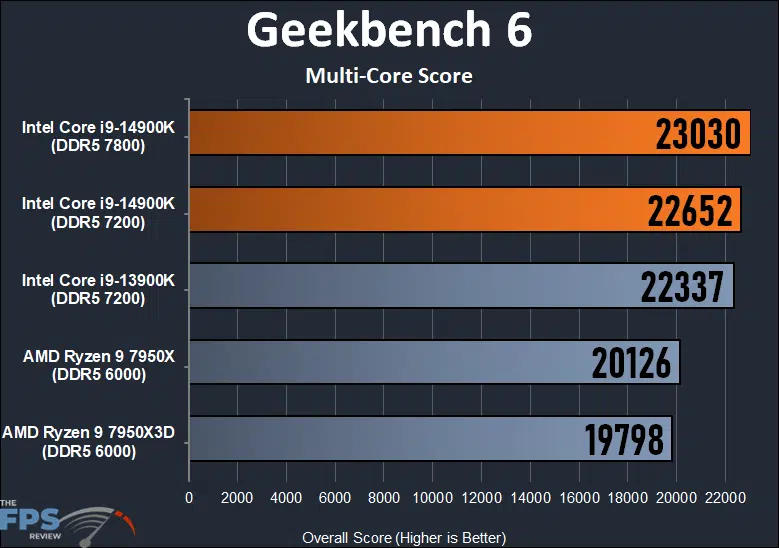
In Geekbench 6 Multi-Core performance we are now looking at multi-core performance, and for this, we actually do see a slight uplift with the faster RAM, but an even bigger uplift compared to the Ryzen 9 7950X. The i9-14900K at 7800MT/s is only about 2% faster than at 7200MT/s. However, compared to the i9-13900K it is 3% faster. When we compare it with the Ryzen 9 7950X it is 14% faster, which is much more significant.
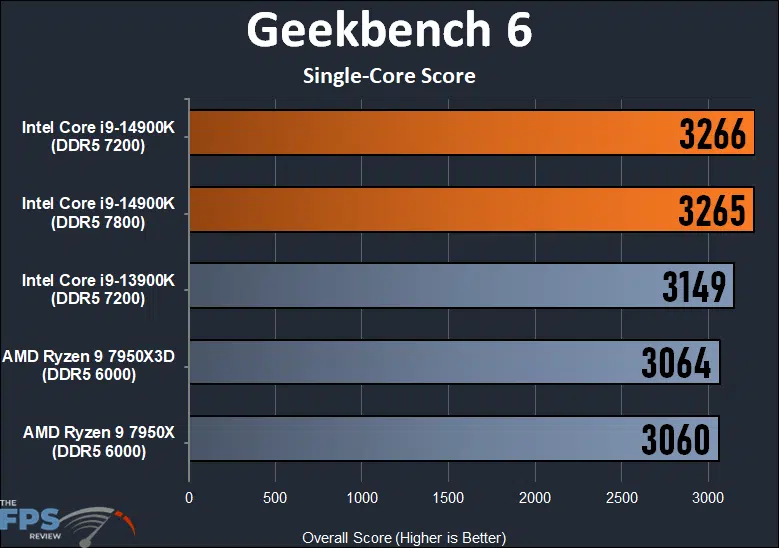
We don’t see any difference with single-core performance differences in RAM speed. However, we do find that it is 4% faster than the i9-13900K thanks to the higher clock speed. Compared to the Ryzen 9 7950/X3D though it is actually 6-7% faster on single-core performance.
3DMark CPU Profile
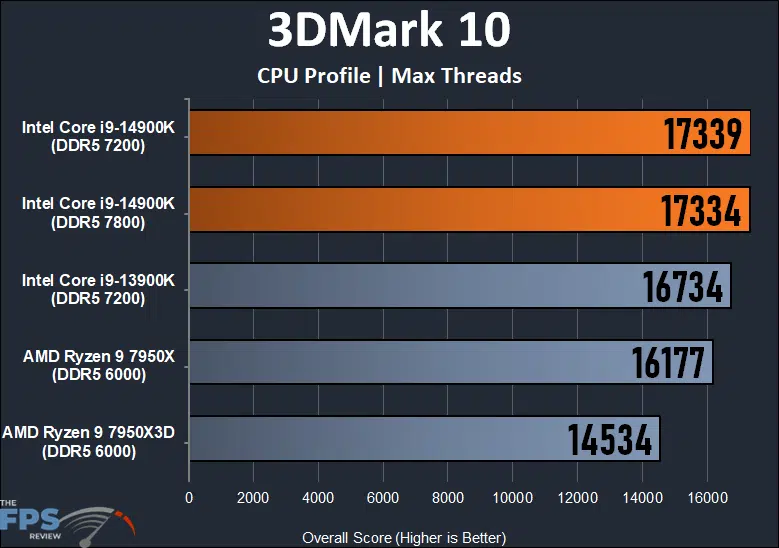
In 3DMark’s CPU Profile test, we are running the “Max Threads” test and looking at overall performance. We do not see any difference between the RAM speeds here. We find that the i9-14900K is 4% faster than the i9-13900K, and 7% faster than the Ryzen 9 7950X. For multi-thread workloads, the 7950X3D falls quite a bit behind the others and is not the CPU if this is most important to you.
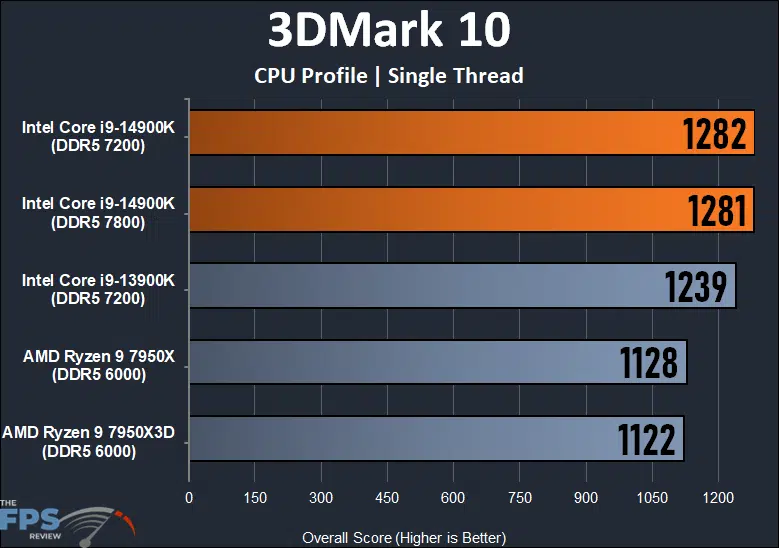
In Single-Thread performance, the i9-14900K rises above the 13900K by about 3%. Compared to the Ryzen 9 7950X though the i9-14900K is 14% faster on single-thread performance, which is a pretty significant advantage.
Discussion (8 replies)
Join Discussion →Nice review. I didn't have really high hopes for this "refresh", but was thinking of maybe a 14700K, but now that just wouldn't make sense.
We have a 14700K in house - it should be on its way to Brent to get the review done (it was used on the launch motherboard review we did).
I ran benches on it for a few days and generally observed it to be on par or slightly faster than the 13900K except for some all core exercises like Cinebench while using the same amount of power.
That is good to hear, but from everything I have read here and have read everywhere else this 14th gen isn't worth the upgrade from my 13600K.
14th Gen was never intended to be an upgrade from 13th Gen.
It was known well ahead of time that it would be just a refresh with a clock speed bump. It's been called Raptor Lake refresh for ages. The results are expected. I don't know why everyone is so shocked.
A lot of people are overreacting for sure. I came in with an open mind that if one of these 14th gen processors were a worthy upgrade then I’d pull the trigger.
Yeah, we had a post about a month ago with the Intel's road map post refresh and by mid-end 24 to early 2025, things look kind of exciting. Panther Lake and the next socket design.
https://www.thefpsreview.com/2023/09/21/intel-confirms-arrow-lake-lunar-lake-and-panther-lake-processor-lineups-will-begin-launching-in-2024-and-into-2025/
Yep and right in line with the next CPU for AM5 right? should be a good time for CPU's, not so much for GPU's I'm thinking. Well 2025 maybe.
Yep, I will be waiting until next year to upgrade I believe. My 13600K is doing fine and should easily last me until then.