
NVIDIA GeForce RTX 5090 – RTX 5070 – RTX 5050
All of the manual in-game run-throughs below are utilizing our “GPU-Oriented” run, which takes place in the open world, between villages, with heavy foliage along the path. All graphics settings are utilizing the “Epic” graphics preset, and NVIDIA Reflex is turned on. With the DLSS testing, we are using the in-game DLSS Quality upscaling setting. The graphs are organized with Patch 2.0 on top, and the sorting is kept the same throughout. The 1% Lows are underneath the AVG FPS.
NVIDIA GeForce RTX 5090 Founders Edition
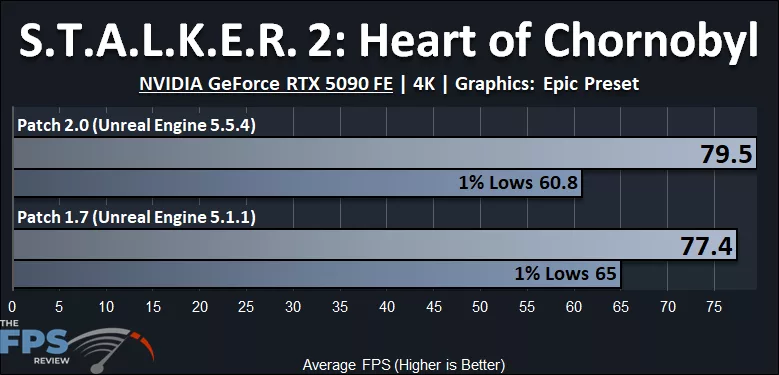
In this graph above, we are running the NVIDIA GeForce RTX 5090 at 4K Native Resolution on the Epic preset. The GeForce RTX 5090 FE does allow a playable experience at Native Resolution, but just barely, with 1% Lows in the lower 60’s. The notable thing here, for this specific video card, is that at 4K, Patch 2.0 is 3% faster than the previous patch on average. However, the 1% Lows take a dive and are actually 6% slower than the previous patch. Note once again, the visuals are different with Patch 2.0; the foliage is noticeably thicker, denser, and looks different/better.
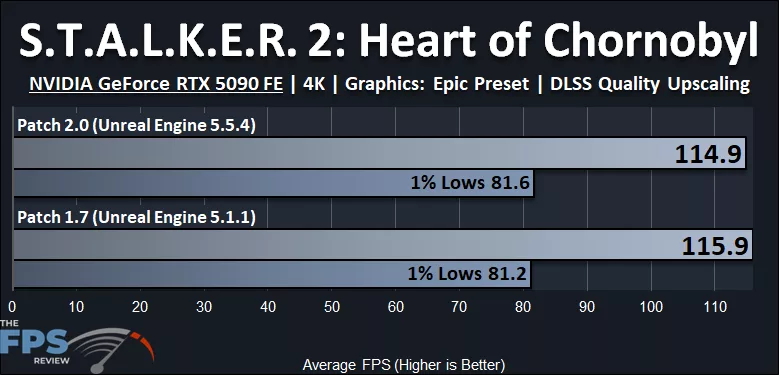
In this graph above, we have simply enabled DLSS Quality Upscaling. With DLSS Quality Upscaling enabled, well, performance is almost identical between both patches; there isn’t any discernible difference. The performance is great though, with 1% Lows at 81FPS the game is super smooth with DLSS Quality Upscaling. Note again, there is a visual difference; Patch 2.0 looks a heck of a lot better, despite the same performance.
NVIDIA GeForce RTX 5070 Founders Edition
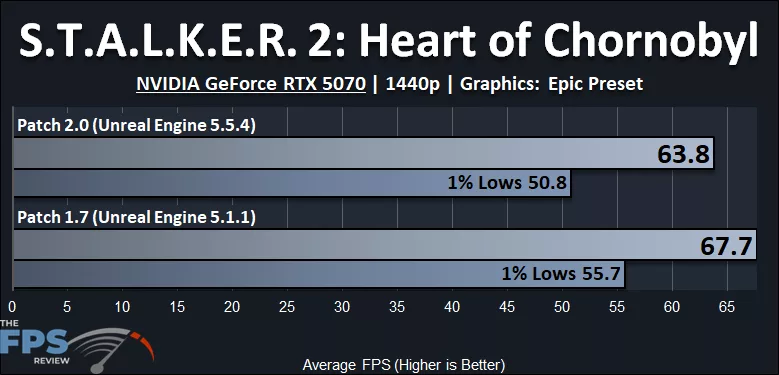
In the above graph, we have the NVIDIA GeForce RTX 5070 running at 1440p Native Resolution. The GeForce RTX 5070 struggles with this setting, and while the average is above 60FPS, the 1% Lows are not. The other thing we notice is that with Patch 2.0, performance is consistently lower. Patch 2.0 is 6% slower on average and 9% slower on 1% Lows. Again, there is a visual difference.
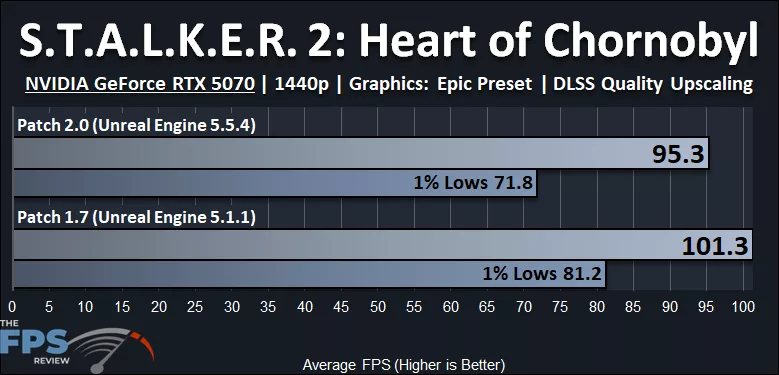
Enabling DLSS Quality Upscaling on the GeForce RTX 5070 does wonders at 1440p, making the game very smooth and playable. However, once again there is a performance loss with Patch 2.0. Patch 2.0 is 6% slower on average and 12% slower on 1% Lows, and visuals are different.
ZOTAC GAMING GeForce RTX 5050 SOLO
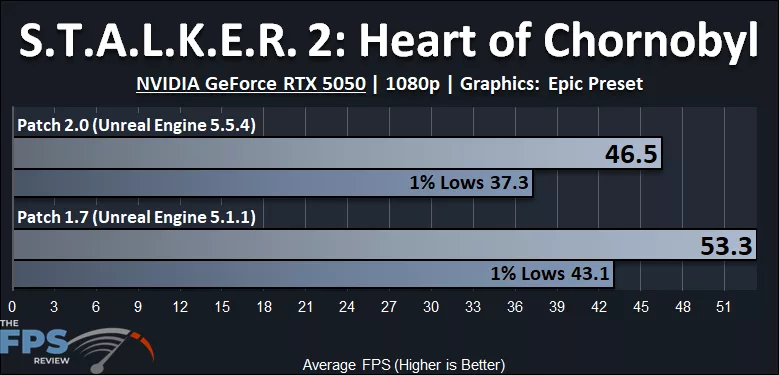
The GeForce RTX 5050 really struggles in this game, even at 1080p, but this is on Epic quality. Patch 2.0 makes it suffer even more, as the added foliage drags it down. Patch 2.0 is 13% slower on average, and 1% Lows are 13% slower.
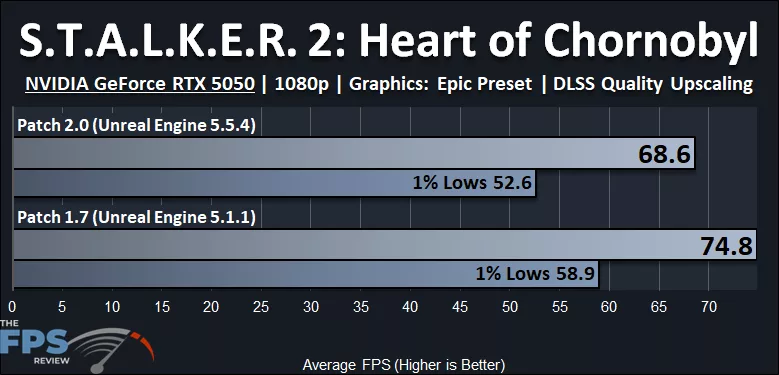
Even with DLSS Quality Ultra, the GeForce RTX 5050 struggles to keep the 1% Lows high enough. Patch 2.0 drags performance here as well; the average is 8% slower, and the 1% Lows are 11% slower, again, visual differences.
Discussion (1 reply)
Join Discussion →The improvements in this game are quite dramatic. The look of the game is really improved. I've not played enough into it to see about the A-Life changes.
Some comparison screen shots would have been a nice addition to the article.