
Specific GPU Comparisons
On this page, we are going to hone in on a few important direct video card comparisons in Phantom Blade Zero. We are using a long manual in-game run-through for testing that takes in every part of the environment. Graphics feature testing will follow on the next page.
4K – RTX 5090 vs RTX 5080
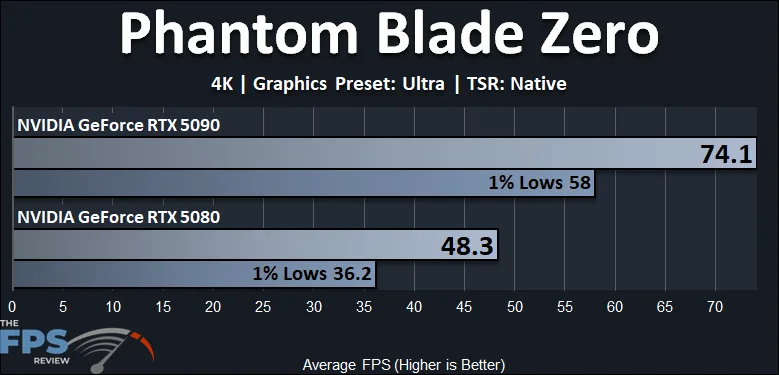
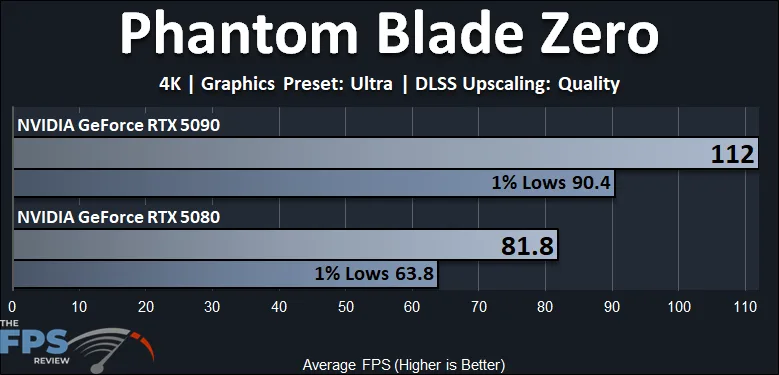
Since we looked at how all of the video cards compared at 1440p, we specifically wanted to see how the GeForce RTX 5080 holds up in this game at 4K. In the graphs above, we are comparing the GeForce RTX 5080 with the GeForce RTX 5090 to see how they scale and perform. In the first graph, we are running at TSR: Native, and the second graph is at DLSS Upscaling: Quality. In the first graph, we can see that the GeForce RTX 5080 is not playable at all at 4K Native; average FPS and 1% Lows are pretty bad. The GeForce RTX 5080 is 35% slower than the GeForce RTX 5090. The GeForce RTX 5090 itself is barely playable, with 1% Lows at 60FPS. When we turn on DLSS Upscaling: Quality, that all changes. The GeForce RTX 5080 is actually playable with an average FPS of 81FPS and the 1% Lows just peeking over 60FPS. The GeForce RTX 5080 is 30% slower than the GeForce RTX 5090 using DLSS.
NVIDIA GeForce RTX 5070 Ti vs AMD Radeon RX 9070 XT
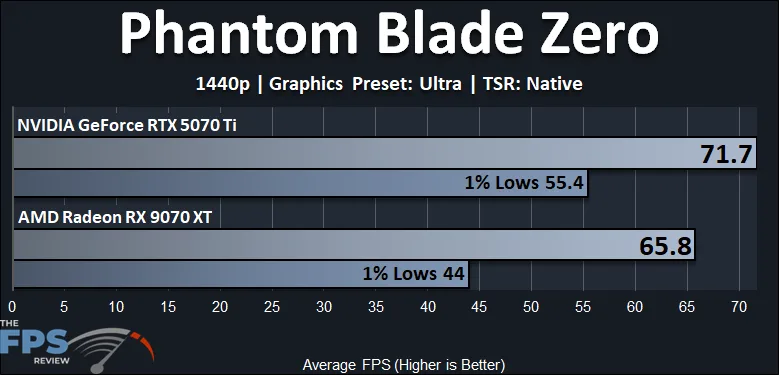
In this graph, we are testing at 1440p with TSR: Native and “Ultra” settings. We wanted to pull this out a bit here and show the performance difference between the Radeon RX 9070 XT and GeForce RTX 5070 Ti. It appears the GeForce RTX 5070 Ti is faster in this game, by 9% in average FPS and 26% in 1% Lows. That 1% Low performance difference is more significant.
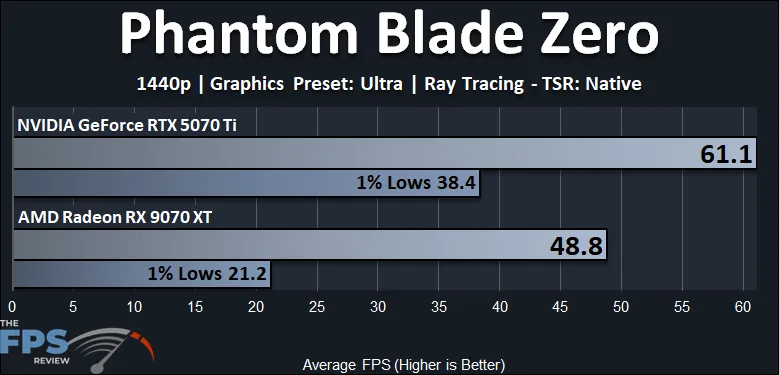
We are going to look at Ray Tracing and Path Tracing more closely in the next page. However, we did want to pull out this test, which is with regular Ray Tracing enabled but at TSR: Native (No Ray Reconstruction and no DLSS or FSR). We can see the disparity here and the struggles AMD has with Ray Tracing in this game. The GeForce RTX 5070 Ti is 25% faster than the Radeon RX 9070 XT when Ray Tracing is enabled, whereas without it, it was only 9% faster in the graph above this one. What’s worse is the 1% Lows: AMD drops the ball big time here; the GeForce RTX 5070 Ti is 81% faster in 1% Lows. We kept getting pauses at times on the Radeon RX 9070 XT with regular Ray Tracing enabled.
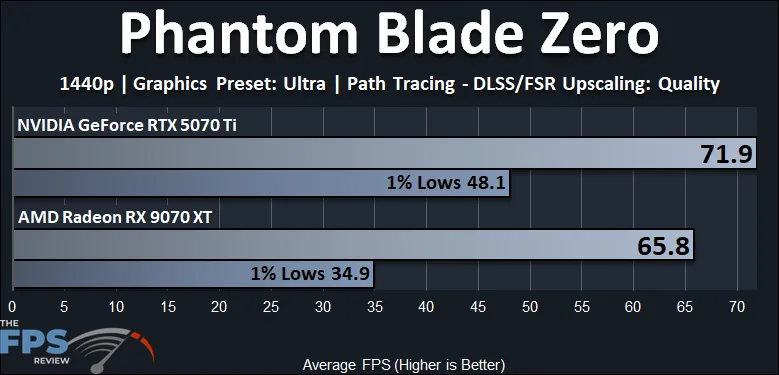
We can go one step further, though, and enable Path Tracing in this game. When we enable Path Tracing, we also need to enable DLSS and FSR Upscaling at Quality. This also includes Ray Reconstruction being enabled on the GeForce RTX 5070 Ti. When Path Tracing is enabled and DLSS/FSR Upscaling is used, the performance difference isn’t as great as it was with regular Ray Tracing. The GeForce RTX 5070 Ti is 9% faster than the Radeon RX 9070 XT, which is the same percentage as it was without Ray Tracing. The 1% Lows are still far apart, though; the GeForce RTX 5070 Ti is 38% faster in 1% Lows. The Radeon RX 9070 XT does better in the 1% Lows with Path Tracing than it does with traditional Ray Tracing (Lumen GI).
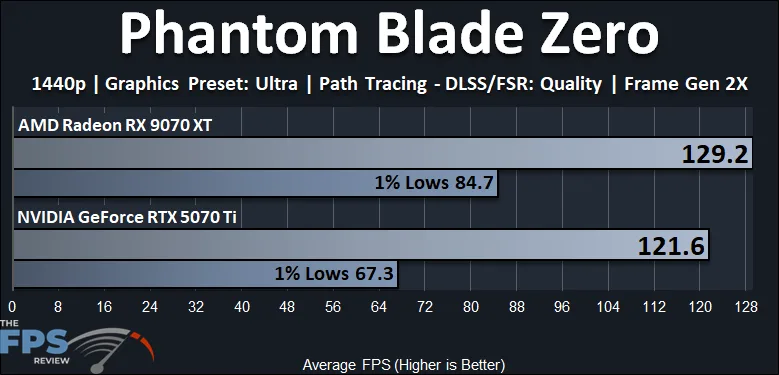
Another aspect to look at is how performance compares with 2X Frame Generation between the GeForce RTX 5070 Ti and Radeon RX 9070 XT. In the graph above, we are running Path Tracing with DLSS/FSR Upscaling on Quality, AND we have 2X Frame Generation turned on with both video cards. Firstly, this does increase the smoothness, and the 1% Lows are above 60FPS. What we see, though, is quite interesting. There is a FLIP: the AMD Radeon RX 9070 XT is actually ‘faster’ than the GeForce RTX 5070 Ti by 6%, and the 1% Lows are way faster at 26%!
1080p – RTX 5070 vs RTX 5060 Ti 8GB vs RTX 5060
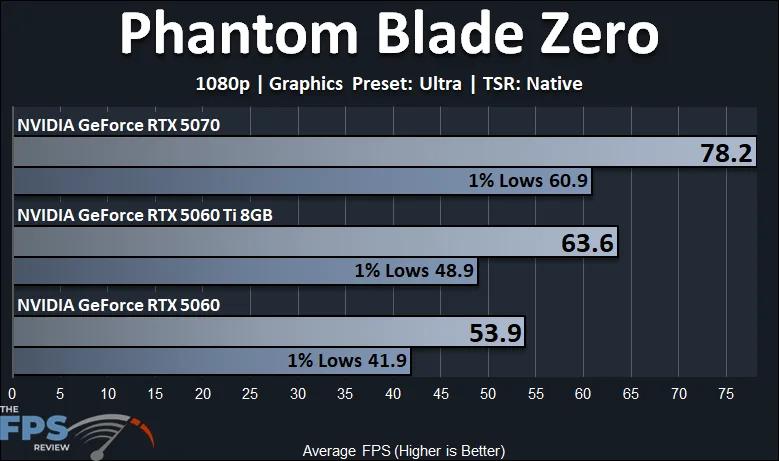
We also wanted to hone in on the more midrange cards at 1080p to compare them, so here are the GeForce RTX 5070, GeForce RTX 5060 Ti 8GB, and GeForce RTX 5060. At 1080p – TSR: Native – Ultra, only the GeForce RTX 5070 can hit 60FPS on the 1% Lows. The GeForce RTX 5060 Ti 8GB can hit above 60FPS on average, but the GeForce RTX 5060 is really not playable at “Ultra” settings at TSR: Native. The GeForce RTX 5060 Ti 8GB is 18% faster than the GeForce RTX 5060, and the GeForce RTX 5070 is 23% faster than the GeForce RTX 5070.
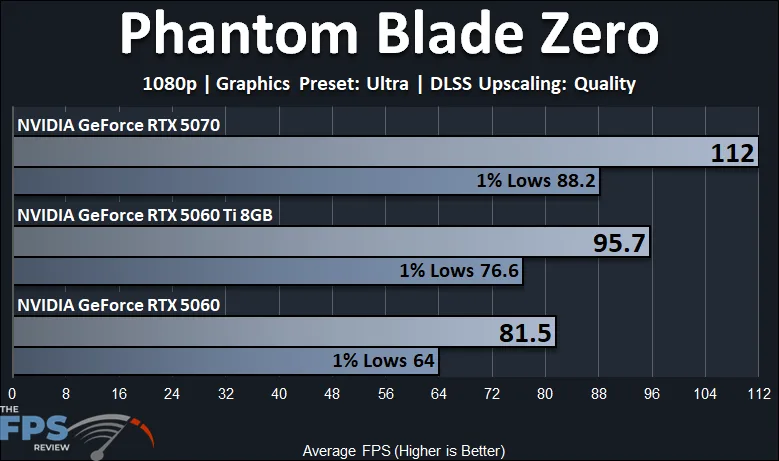
When we enable DLSS Upscaling: Quality, all of that changes. Even the GeForce RTX 5060 is now playable, with smooth performance and 1% Lows above 60FPS at 1080p. The GeForce RTX 5060 Ti 8GB is 17% faster than the GeForce RTX 5060, and the GeForce RTX 5070 is 17% faster than the GeForce RTX 5060 Ti 8GB.
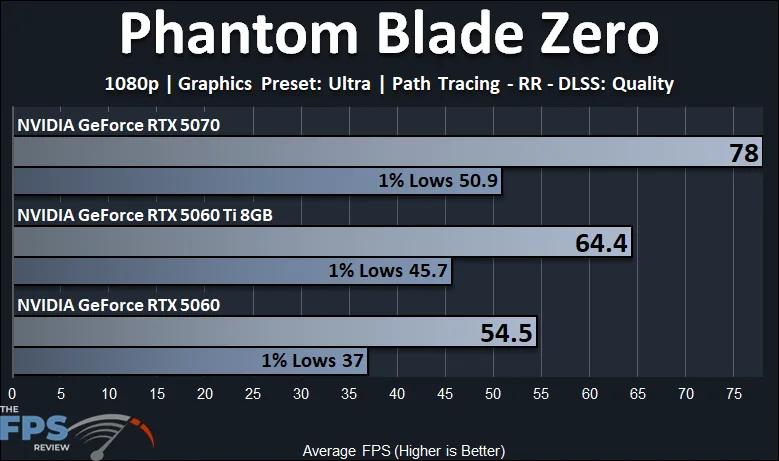
We, of course, wanted to try Path Tracing on these midrange cards, but we do need to at least try it with DLSS Upscaling turned on at Quality. The GeForce RTX 5070 comes the closest to being playable, but the 1% Lows are only hitting 50FPS at max. The other two video cards simply are not playable at these settings. The GeForce RTX 5060 Ti 8GB is 18% faster than the GeForce RTX 5060, and the GeForce RTX 5070 is 21% faster than the GeForce RTX 5060 Ti 8GB.
Discussion
Join Discussion →No replies yet. Be the first to reply on the forum.