Gaming Benchmarks Part 3
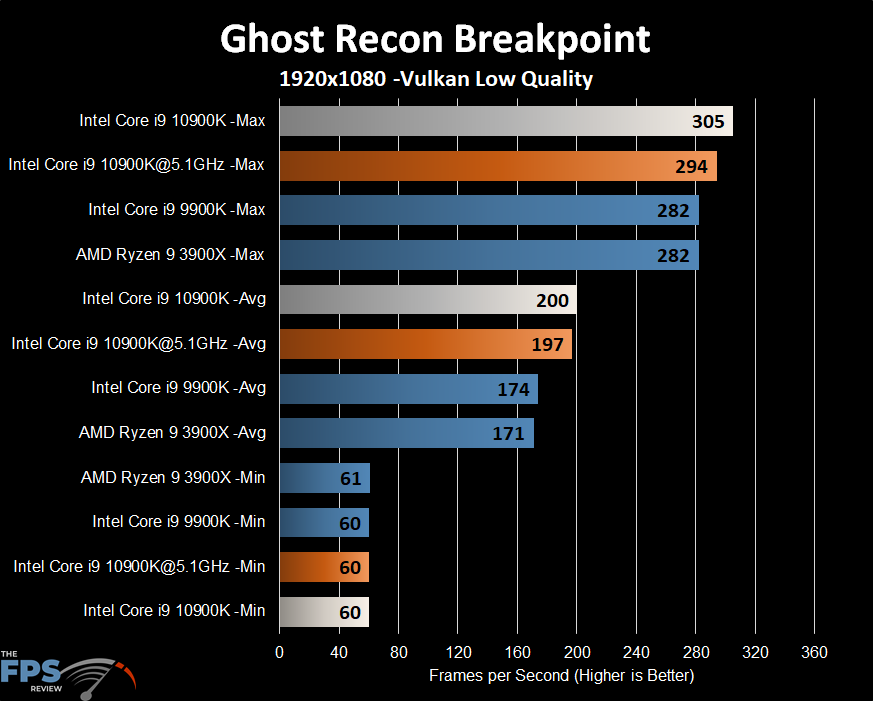
Thanks to recently added support and content patches for Ghost Recon, its become quite a good game. Weirdly, AMD has the highest minimum FPS here. The 3900X is also strangely close to the Intel test systems. That said, Intel does match or exceed the 3900X. Though it seems to take the 10900K to do that whereas the 3900X and 9900K were almost evenly matched.
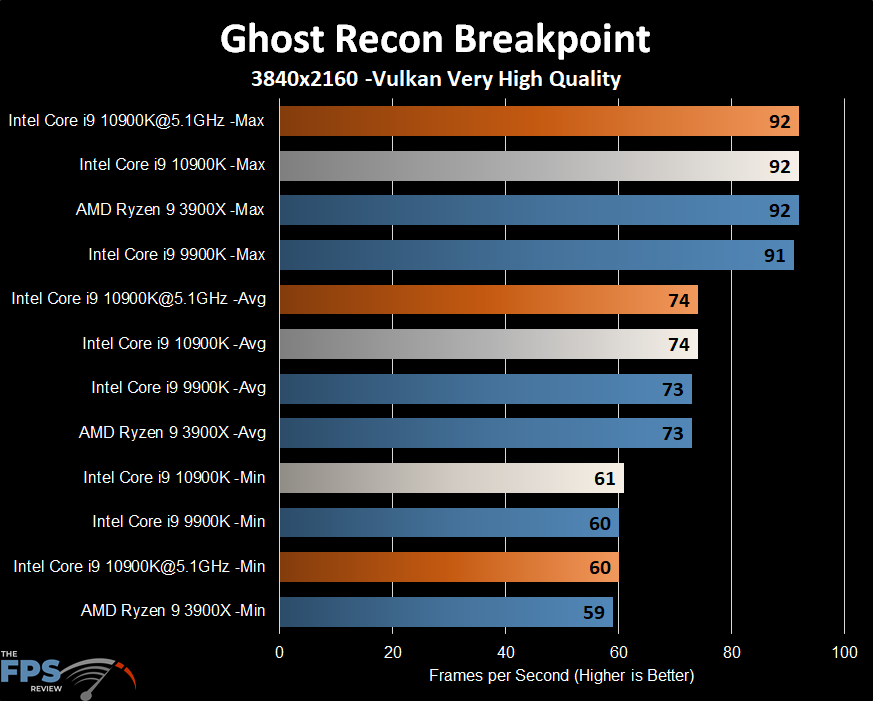
Even with the Vulkan renderer, 4K is rough on the GPU and CPU. With a 2080Ti you can get away with slightly higher settings, so we are using the Very High preset here. In any case, all of the CPU’s can maintain right around a 60FPS minimum. The super close results across all test platforms indicate that we are absolutely GPU bound in this game and resolution.
Doom Eternal
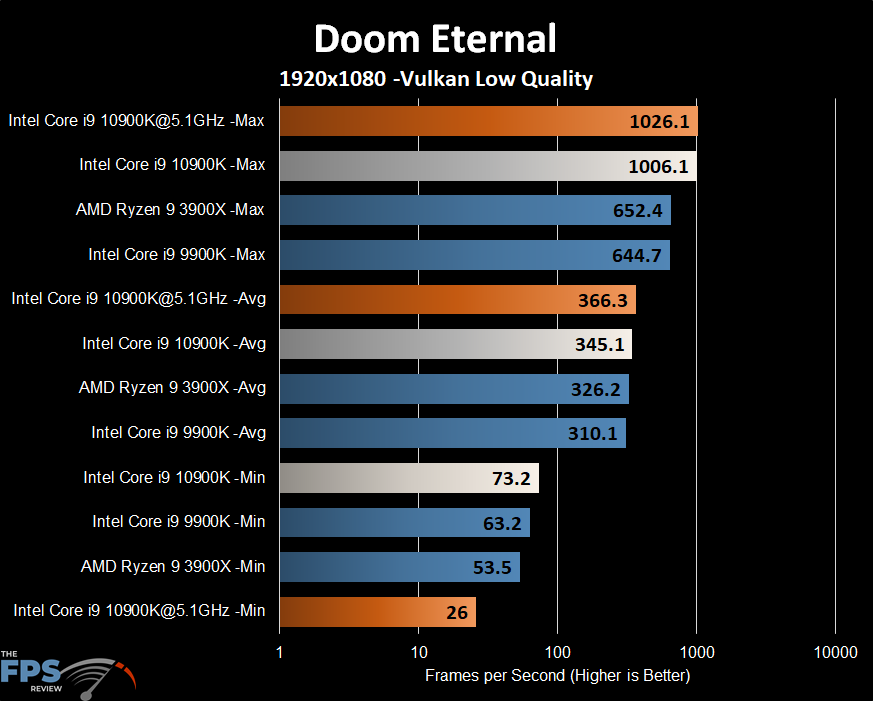
This is another Vulkan game. Oddly, the 10900K when overclocked falters in terms of minimum frame rates. This game’s performance was measured by Frame view. I never noticed this slowdown, but never the less it evidently occurred. In any case, at low-quality settings this game is smooth enough you can probably run it on a fairly old PC and be OK.
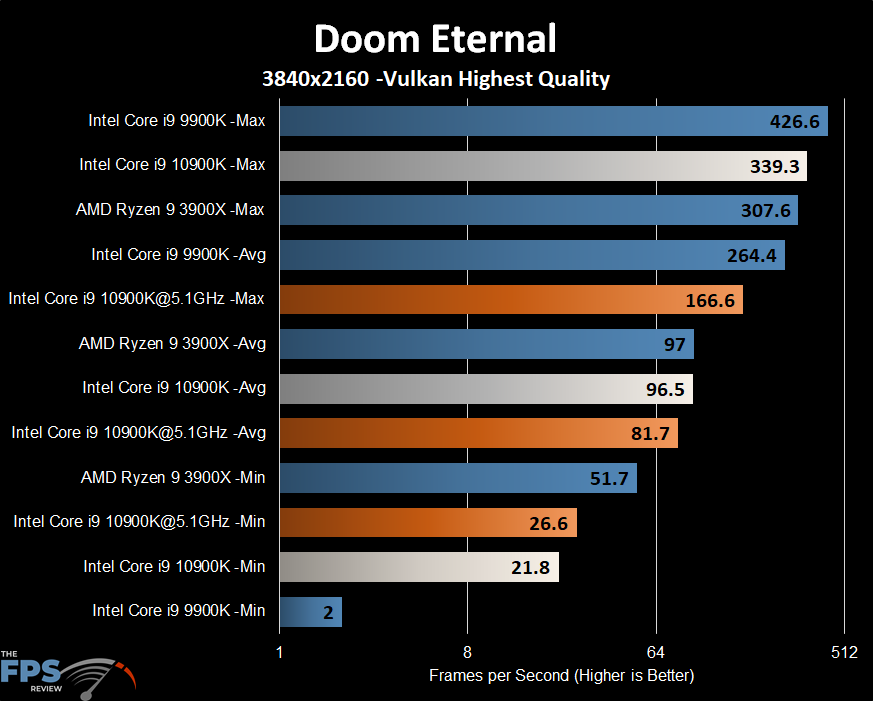
Unfortunately, at 4K, this game is literally all over the place in terms of frame rates. This is something we may have to revisit. Being a manual run-through using Frame view, it’s possible I did something different to cause this, although I can’t imagine what that could have been. More testing is required here.
Oof missed that. Was the platform unable to hit 3600?
Yes, it can easily hit DDR4 3600MHz speeds and more. I’ve addressed the Ryzen 3000 / X570 memory speeds in previous CPU and motherboard review articles. Given the time allotted for getting the 10900K review done by the embargo date, I was not able to retest the 3900X and 9900K under overclocked conditions. Even if I had, memory overclocking is handled separately as we try to keep that variable out of the benchmarks unless that’s what we are testing.
It will be interesting to see what happens to code that has been heavily optimized for a 10+?? year old instruction set actually has to run on something new.
This is what AMD is doing and I think that is a large reason so many of the normal work and Gaming examples were performing better on Intel. (Other than raw execution speed)
I might be way off base in thinking that coders are using older optimizations that simply don’t exist on the newer AMD silicone.
It’s worth noting that Ghost Recon Breakpoint was optimized for AMD silicon and it shows. The results between the 9900K and the 3900X are quite similar. The only reason why the Core i9 10900K beats either of them comes down to clock speed and additional cache. That and the extra threads don’t really matter. If I recall correctly, Ghost Recon Breakpoint only sees 12t or at least, that’s all it shows in the in-game performance metrics. Something like that.
Any chance of a quick retest when the new doom patch hits next week orso to see if that did anything?
Yes. I’d have looked more into the anomalous performance if I had the time. That said, its easily something I could have done differently. Those are Frameview captures of manual run throughs. I could have done something with the camera, or did something slightly different that caused that in some of the runs. If you run into a wall and stare at it in most games your FPS shoots up, or if you explode an enemy at point blank, it can drop substantially. That’s why I prefer canned benchmarks for these types of things, but not every game that people are interested in has built in tools for that.